Bottom line up front
Short answer: on a solitaire the diamond is the whole ring, so price and verify the stone first and buy it from a manufacturer, cutting house or dealer. The mount comes second.
- Nowhere to hide. No halo, no pave, no accent stones. Cut, eye-cleanliness and facing colour are all exposed in daylight, which is why a downgrade shows on this setting and nowhere else.
- Cheaper. A retailer buys its centre stones at exactly that level and then roughly doubles the price, about three times at a branded name. One step earlier is the same stone without that doubling.
- Better. Roughly five times more of the stock reaches D to G colour with VS2 clarity or better there: 52 percent through trade access against 9 percent sitting in retail cases.
- The number. A loose one carat G/VS1 Excellent works out at roughly R72,000 to R92,000 including VAT on the published list, and a plain gold or platinum mount adds a small fraction of that. So if two “1 carat” quotes differ by R20,000, the gap is the stone, not the ring.
- They set and service it too. The mount gets made around your stone, and resizing, cleaning, re-tipping, re-plating, valuations and buy-back run off the same bench. Most dealers, manufacturers and cutting houses run one or work with one, which is where a counter usually sends the job.
Use a showroom instead if there is a close date on this, if your partner wants a dozen finished mounts on her own hand this afternoon, or if the name on the box is part of what is being given. Insist the diamond appears as its own line with a GIA number you can check either way.
Why solitaire is the most honest setting to buy
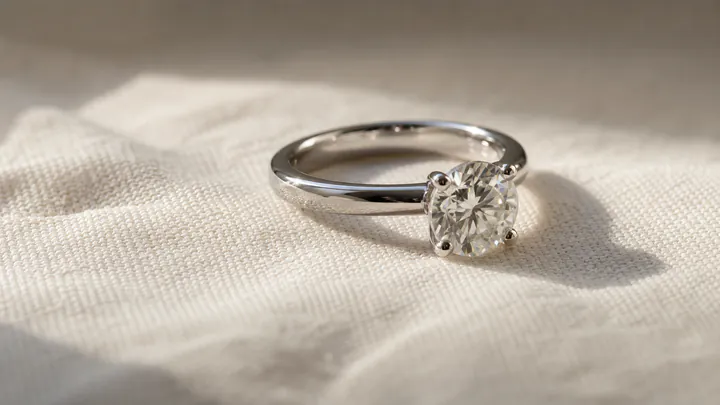
A halo, a hidden halo, or a cluster of pavé can make a smaller or lower-grade diamond read bigger and brighter. That is not dishonest in itself, but it changes what your eye is judging. A solitaire removes all of that. The centre stone sits alone, lit from every side, with no accent stones to carry it. Cut quality, eye-cleanliness and the facing colour are all exposed in plain daylight.
That is why I tell first-time buyers a solitaire is the most honest setting on the market. It is also why the spec on the report matters more here than on any other style, and why I would only buy the centre stone from someone who lets me see it first. With most online sellers you pay before you ever look. Find a seller who will put the actual diamond on the table, and the one stone your whole ring depends on can be examined before a cent moves, which is the entire argument for buying a solitaire that way. The diamond buying checklist sets out the questions that get you there. If you are still weighing styles, our notes on halo engagement rings explain exactly what a halo hides and what it adds, so you can decide with eyes open.
Where the money actually goes
Spec drives price far more than carat alone, and on a solitaire that is brutally visible. Two anchors are worth holding on to, and they come from different places:
| One carat | Figure, incl VAT | What it is |
|---|---|---|
| Loose G VS1 Excellent stone | R72,000 to R92,000 | Rapaport round list, 20 March 2026, $5,400 per carat, less the 10 to 30 percent the trade transacts under list, at R16.50 to the dollar plus VAT. About R82,000 at 20 percent off |
| Finished ring, premium South African showroom | R105,000 to R428,000 | My July 2026 pricing. A ring including its setting, drawn from three listings of three different specifications |
Read the first row before the second. It holds a single fixed specification, G colour, VS1 clarity, Excellent cut, at one weight, and it still runs from R72,000 to R92,000 including VAT. None of the four Cs explains that spread, because the four Cs are held still inside it. What varies is only the discount off list, which is the make, the market and the seller’s own position. Now let the colour and the clarity move as well, which is what happens the moment a quote says only “1 carat”, and the range under those two words gets far wider again.
The second row is a different object and must not be read as the first row plus a rip-off. It contains a setting, bench work and a counter. I publish it as a band rather than as a rate card of individual stones and prices, and that is deliberate: a band across eighteen sellers describes a market, while a single weight, colour, clarity and rand figure describes one business. The working rule for a solitaire falls straight out of all this. Two quotes are comparable only when the weight, colour, clarity, cut grade and grading laboratory are identical on both, and when both either include the mount or exclude it. Until then you are not comparing prices, you are comparing descriptions.
The three sellers behind a solitaire quote
When you ask three South African sellers for “a 1 carat solitaire”, you are usually dealing with three different business models, and on this one setting the difference between them matters more than on any other.
Budget retail, selling out of the case. This is the dangerous one for a solitaire, and I can put a number on why. Last June I worked through 230 individually listed GIA-certified natural diamonds at six South African sellers, scoring each on colour and clarity. Of the stones sitting in South African retail cases, 9 percent reached D to G colour with VS2 clarity or better. Roughly one stone in eleven. A halo or a pave shoulder can carry a diamond that sits below that bar. A solitaire will show it to everybody who looks at the hand.
Sellers listing against a catalogue and sourcing on demand. Trade-access stock in that same June sample was far stronger, 52 percent past the same bar, and the reason is reach: a catalogue bigger than anything a business could warehouse is how an exact specification actually gets found. That part is ordinary trade and it is often the only way to get what you asked for. What is not fine is what usually follows. Nobody there looks at the stone, and neither do you, until it has been paid for. On a solitaire, where the whole ring is that one stone and the make decides how it behaves in light, that is the risk worth refusing. Ask to see it first, and ask who chose it.
A cutter or dealer holding certified stock of its own. Here the diamond is already in the country, in a drawer, and you can put it under a loupe before a cent changes hands. I did not measure this group as a separate priced category, so I am not going to invent a per-carat figure for it. What I will say is that it is the only one of the three where you can confirm, in advance and with your own eyes, that the stone on the report is the stone going into your ring. On a setting with nothing else on it, that is worth more than it sounds.
Why a stock-holding cutter suits a solitaire
One stone, one report, one decision. That is what makes the process questions so easy to ask here, and so revealing when they get dodged. Is this exact diamond in the building, or is it still a line in a catalogue. Who looked at it, and what did they reject before it. Will you quote the loose stone as its own line with the report number attached, so I can check the paper and the girdle inscription myself. What happens if I see it and walk away. A seller holding certified stock answers all four without pausing, because none of the answers cost them anything. The diamond buying checklist is the longer version, and on a solitaire it is worth working through properly, because there is no second stone to carry the first one.
Choosing the mount, once the stone is sorted
Only after the diamond is chosen would I talk metal and prongs. The mount is the smaller decision, but a few solitaire-specific things matter.
- Four prongs show more diamond; six prongs hold it safer. Four prongs reveal more of the stone’s outline and more light, which suits a beautifully cut diamond. Six prongs cover a little more but are kinder to an active, hands-on life. Either way the prong work must be clean, because on a solitaire a clumsy prong is the only flaw on the whole ring.
- Platinum versus white gold is a maintenance choice. Platinum is denser and naturally white, but it develops a soft patina over years that some people love and some have re-polished. White gold is plated in rhodium for that bright white, and that plating wears and needs re-doing every couple of years. Our white gold engagement rings guide covers the re-plating reality in full.
- Set height to the hand, not the photo. A high cathedral setting looks dramatic but catches on everything. A lower setting wears better day to day. For a ring meant to be worn for decades, I lean low and secure.
Keep the mount simple if the stone is excellent. A strong natural diamond does not need decoration, and on a solitaire, decoration is usually a sign the stone could not stand alone. If you want the diamond and the mount truly built around each other, our custom diamond rings notes walk through how to brief a maker without overpaying for theatre. And to sanity-check any quote, hold it against the broader South African diamond price index, which sets out the same July price harvest in full.
The one rule for a solitaire
Buy the report, not the ring. Get the loose natural diamond priced as its own line with a GIA number you can verify independently, see the actual stone if you possibly can, and only then build the setting around it. On a solitaire the diamond is the whole ring, so every rand of confidence you can put into that one stone is rand well spent.
One practical way to find sellers who work like that: search the price rather than the shop. Look up what a carat costs, in those words, and the sellers who publish a per-carat number in public are the ones prepared to be measured on the stone. That is the right starting point for a setting where the stone is the entire product.