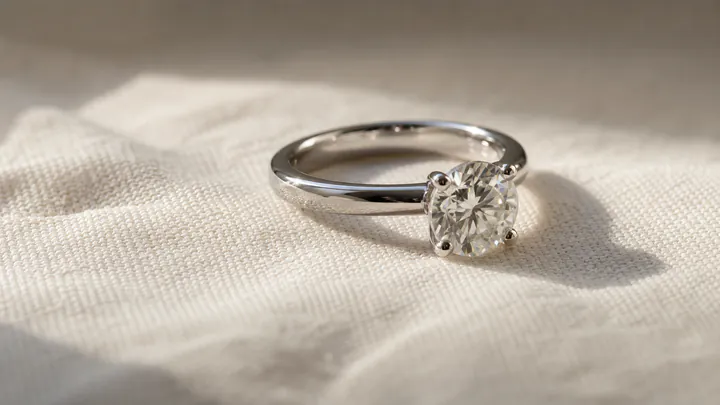
Short answer: choose 18ct white gold, then spend the argument on the diamond and buy it from a manufacturer, cutting house or dealer.
- The metal is the cheap part. On a solitaire the 18ct white gold mount is a few thousand rand of metal and bench labour. The natural GIA centre stone is almost the whole invoice, so settle the stone first and the metal last.
- Cheaper. A retail counter buys that stone at exactly that trade level and then roughly doubles the price, about three times at a branded showroom. Same stone, one step earlier.
- Better, and this metal makes it matter more. The specification most buyers want is about five times more common at that level, 52 percent of trade-access stock against 9 percent of retail-held stock, and a bright white setting shows a tint rather than hiding it.
- They do the rest too. Setting, bespoke work, resizing, re-tipping, rhodium re-plating, insurance valuations, repairs and buy-back, usually on their own bench.
Go to a showroom instead if the proposal date is a few weeks out, you want to try a dozen made-up rings on a real hand, or you want the brand and the box. A counter you can walk back into for the re-plating this metal genuinely needs is an argument specific to white gold.
White gold engagement rings in South Africa, the metal is the cheap part
I have watched couples agonise over white gold versus platinum for twenty minutes and then spend ten seconds glancing at the diamond, which is exactly backwards. On a solitaire, the 18ct white gold setting is a few thousand rand of metal and bench labour. The natural GIA centre stone is almost the whole invoice. So the first true thing to know about white gold engagement rings in South Africa is that the metal decision barely moves the price. The stone decision moves everything.
That said, white gold has real, specific behaviour that a good jeweller will tell you and a quick online checkout never will. And the diamond it frames is worth seeing before you pay. With most online sellers the stone arrives only after the money does, having passed through a chain of hands to reach you, and nobody in that chain has necessarily opened the parcel. The fewer hands between the cutting and the counter, the fewer opportunities there are for the stone on the report to stop being the stone in your hand. The diamond buying checklist sets out how to establish that before you pay rather than after. Here is what actually matters once the diamond is sorted.
What white gold really is, and the rhodium truth
White gold is not naturally white. It is the same yellow gold, alloyed with paler metals to lift the colour, and then electroplated with rhodium, a bright platinum-group metal, to give that crisp white shine. That plating is the thing nobody mentions at the till.
Rhodium plating is microns thick. It wears at the points of highest contact, the back of the band where it rubs your finger and the underside of the claws, and as it thins you start to see a faint warm cast coming through. On a ring worn every day, that is usually twelve to twenty-four months before it wants a refresh. A re-plate is a small routine job at any South African jeweller, commonly R400 to R900. None of this is a defect. It is simply how white gold works, and if you would rather never think about it, that is the honest argument for platinum, which is white all the way through and only develops a soft patina.
A second point the trade knows: the alloy matters. Cheaper white gold is nickel based, and once the rhodium wears through at a contact point, some nickel-sensitive wearers react against the skin. If you know you have that sensitivity, ask specifically for a palladium-white-gold alloy before the ring is made. It is an easy request up front and an expensive regret afterwards.
18ct or 9ct, and why it changes the band more than the look
For an engagement ring I specify 18ct white gold. It is 75 percent pure gold, the same gold content as 18ct yellow, with a quarter white alloy. 9ct white gold is only 37.5 percent gold, harder, greyer in its raw state, and cheaper, and it is fine for fashion pieces, but on a ring that will be worn for decades the 18ct alloy machines cleaner, takes claws better and re-polishes more kindly over a lifetime of sizing and repairs.
White gold also flatters a near-colourless natural diamond. A bright white setting holds a G or H stone looking crisp and white. The trade-off, and this is the quiet one, is the reverse: a very white setting can make a faint yellow tint in a lower-colour stone read more obviously by contrast. If you are buying in the J to K colour range and want the warmth hidden, yellow gold actually helps, because the metal facing up into the stone masks the tint. White gold gives you nowhere to hide a weak colour grade. One more reason to get the stone right first.
What you are really paying for
Here is the part that protects your money, and on white gold it has particular teeth, because of the colour point I made two sections up.
In June 2026 I recorded the specification of 230 individually listed GIA-certified natural diamonds at six South African sellers, scoring each one for D to G colour with VS2 clarity or better. Of the stock held in South African retail cases, 9 percent cleared that bar. Of the stock reachable through trade access, 52 percent did. Now put that next to the metal. A bright white setting reveals a warm tint rather than masking it, so the colour grade you accept matters more in white gold than in yellow, and the display case in front of you is statistically the least likely place to be holding the grade a white setting wants.
On price, two figures are worth carrying, and they are different kinds of number. The first is arithmetic on the published list, so you can redo it: Rapaport’s round list of 20 March 2026 prices G colour, VS1 clarity in the one carat bracket at $5,400 per carat, and at the 10 to 30 percent under list the trade transacts at, converted at R16.50 to the dollar with 15 percent VAT added, a loose one carat runs about R72,000 to R92,000. The second is what I found on the shelf: across 73 one carat listings at 18 sellers in July 2026, 17 of them South African, finished one carat rings at premium showrooms ran R105,000 to R428,000. That second figure includes a setting and rests on three listings of three different specifications, so it is not the first figure with a mark-up bolted on. I publish it as a band rather than as individual stones with prices attached, because a band across eighteen sellers describes a market while a single row points at one business.
Wherever your ring lands, the 18ct white gold mount around the stone is a small line item. So if a finished white gold ring looks suspiciously cheap, the saving is almost never in the metal. It is in the stone. Ask exactly which colour and clarity you are getting, on a GIA report, in writing, and remember that white gold is the metal least willing to keep that secret for you. The method behind both studies sits in the South African diamond price index.
How I would actually buy one
Choose the natural GIA centre stone first and get its loose price separately from the setting. A good seller will quote the diamond and the white gold mount as two numbers, which instantly tells you whether you are paying a fair stone price or a marked-up package. Then choose your setting style. White gold suits almost everything, a clean solitaire, a sparkling halo that uses the bright metal to widen the face-up look, or a three-stone.
Then judge the seller on what they will let you check, rather than on the name on the shopfront. Those two numbers are the first test. The second is whether the report number arrives with the quote, so you can verify it on your own phone and match it to the inscription on the girdle. The third is whether the stone is here or still a listing, and on this metal that question carries extra weight, because a bright white setting is the one mount that will not hide a colour grade you were told about but never saw. A re-plate fixes the metal every couple of years. Nothing fixes the stone. The diamond buying checklist covers the rest, including the return and buy-back wording worth having in writing before any money moves.
A white gold engagement ring should be an easy, bright, sensible choice in South Africa, and it is, as long as you spend your attention where the money actually is. The metal is the frame. The natural diamond is the picture.