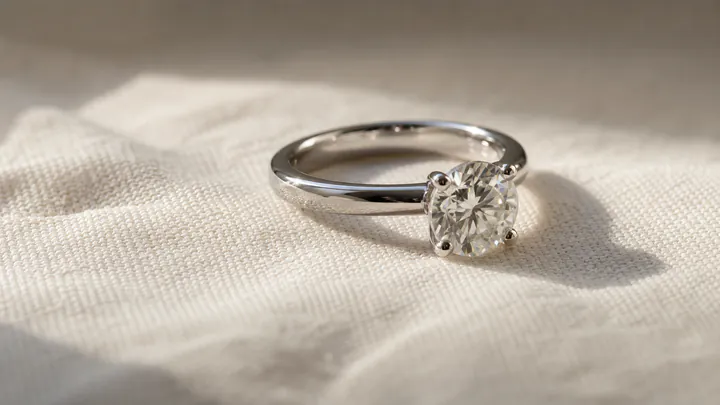
Short answer
Short answer: a loose one carat G/VS1 Excellent works out at roughly R72,000 to R92,000 including VAT on the published list. Buy it from a manufacturer, cutting house or dealer, with the setting on its own line.
- Cheaper. A retail counter buys at exactly that level and then roughly doubles the price, about three times at a branded showroom. That doubling lands once, when the stone leaves the trade for a retail floor, and buying before it is the whole saving.
- Better. Around five times more of the stock reaches D to G colour with VS2 clarity or better there: 52 percent through trade access against 9 percent sitting in retail cases.
- Cut is the whole game on a round. It is the one shape GIA grades for cut, and Excellent is a wide band. The difference between merely Excellent and superb gets settled by whoever can put the stone in your hand under daylight.
- They set and service it too. The mount is built around your stone, and resizing, re-tipping, re-shanking, valuations and buy-back run off the same bench. Most dealers, manufacturers and cutting houses run one or work with one, which is where a counter usually sends the job.
Use a showroom instead if the proposal date is a few weeks out, if your partner would rather try twenty finished settings on her own hand this afternoon than choose from a stone and a drawing, or if the brand and the box are part of it. Keep the stone quoted separately from the mount either way.
The round brilliant is currently the only shape GIA grades for cut
That single fact should shape how you buy one. As of 2026, ask GIA for a report on an oval, a pear, a marquise or an emerald cut and you get colour, clarity and carat, but no overall cut grade. The round brilliant is the exception. That exclusivity has an expiry date on part of it: GIA confirmed on 14 June 2026 that marquise, oval and pear will get cut grades in 2027, while cushion, emerald and princess are not in that first wave. For now, and for every stone on a shelf today, the round is still the only report that hands you the grade. GIA assesses its proportions, polish and symmetry and prints a cut grade from Excellent down to Poor. So when you compare two round brilliant engagement rings in South Africa, you are comparing two certificates that actually mean the same thing. That is a real advantage, and it is why I send nervous first-time buyers to a round before anything else.
It also explains the price. A round wastes the most rough of any cut. To turn a rough crystal into a polished round brilliant, the cutter typically loses about 60 percent of the weight to the wheel. You are paying for carats that ended up as dust. A pear or an oval keeps far more of the crystal, which is why those shapes read larger per rand. The round costs more for the same carat because it is the hardest, most wasteful shape to cut well, and the framework to prove it was cut well is the whole point. On the one shape where cut is the whole ballgame, that grade is worth buying from someone who will answer for it personally rather than from a seller shipping in a stone they have never held. A seller who grinds their own rounds to GIA Excellent can put the actual stone under a light and let you tilt it with the person who ground its facets standing next to you. The diamond buying checklist covers how to establish whether that is what you are dealing with before you go.
The spec I would request
The round brilliant rewards precision, so be precise with the supplier:
| Decision | My starting point |
|---|---|
| Stone origin | Natural diamond only |
| Lab report | GIA |
| Cut | Excellent |
| Polish | Excellent |
| Symmetry | Excellent |
| Colour | G to H for value, F if budget allows |
| Clarity | VS2 to SI1, eye-clean |
| Fluorescence | None or faint |
Triple Excellent is not snobbery on a round. Cut grade is what makes the diamond throw light, and a well-cut G can out-sparkle a lazily cut F. If you only spend extra on one thing, spend it on cut. Once you are at Excellent cut, you can drop colour to H and clarity to SI1 and still have a stone that faces up white and clean to the naked eye, which is where most of the value lives. The same money chases very different things in a solitaire setting versus a halo, so decide the stone first and the setting second.
What it really costs, with real numbers
Most price guides quote a single headline number for a one carat round, which is close to useless. The round is the one shape where you can build the number yourself instead, because the trade’s benchmark list is a round list. Rapaport’s round list of 20 March 2026 prices G colour, VS1 clarity in the 1.00 to 1.49 carat bracket at $5,400 per carat. That is an asking price, and the trade transacts under it, commonly 10 to 30 percent off depending on the make, the market and the stone. Run it out:
$5,400 per carat x (1 minus the discount) x 16.50 rand per dollar x 1.15 VAT- Rap less 10 percent: R92,200 for the loose stone, incl VAT.
- Rap less 20 percent: R82,000.
- Rap less 30 percent: R71,700.
So a defensible answer for a loose one carat G VS1 Excellent is roughly R72,000 to R92,000 including VAT. Every input is published, so when the list moves on a Friday or the rand moves overnight, redo the line rather than quoting this one.
The shop end is a different object. In July 2026 I priced 73 one carat listings across 18 sellers, 17 of them South African, spanning premium showrooms, mall chains and online sellers, with 71 of the rows carrying a price. Finished one carat rings at premium showrooms ran R105,000 to R428,000. That band includes the setting and rests on three listings of three different specifications, so it tells you what a showroom charges for “a one carat ring” rather than what one particular stone costs three different ways. Do not read the distance between the two as a saving: one is a bare stone and one is a finished ring. What it does tell you is where to ask questions. The full picture is in our diamond price index for South Africa and our 1 carat diamond price guide.
Why the cheapest round is usually not the round you think you are buying
When you see a 1 carat round brilliant advertised far below those bands, two things are usually happening.
The first is specification. In June 2026 we listed 230 GIA-certified natural diamonds across six South African sellers and split them by where the stone was physically held. Nine percent of the stock sitting on a South African retail shelf reached D to G colour with VS2 clarity or better. Through trade access the same standard was met by 52 percent. That is a comparison of what is stocked rather than of price, but the consequence for a round buyer is direct. The cheap headline round is usually a lower colour and a lower clarity than the one you pictured, and it often arrives with the cut grade left off the ticket entirely. On a round, that omission is the tell, because the round is the one shape where GIA would have printed the grade.
The second is that nobody has looked at it. A seller who sources on demand buys the stone in once you order, which is ordinary enough, and on a round it is often how you find a genuinely top make instead of a mid-band Excellent. The part the website never says plainly is that nobody there tilts the stone before it reaches you, and you pay before you do either. On a round brilliant, where light return is the entire value proposition and Excellent covers everything from superb to ordinary, a diamond nobody has watched in daylight is a real gamble.
In the other direction, when a round costs far more than those bands, the reason is usually not the stone at all. Retail convention is keystone: the counter price is roughly double what the stone cost the counter, and a branded showroom runs to about three times, while the margins between one trade level and the next are thin at commonly 3 to 5 percent. That doubling lands once, at the moment the stone leaves the trade for a retail floor, and it pays rent, stock, staff, insurance and a brand. It is not a swindle. It is simply not sparkle, and no cut grade on the report is doing it.
Where I would buy, and why
On a round, the seller you want is the one who will let you hold a printed cut grade against the actual stone in daylight. Finding them is a search problem, and the obvious words fail. Almost nobody in South Africa searches for a diamond dealer or a diamond wholesaler, and the thin results those terms return do not contain the sellers worth your afternoon. Ask the search engine about price. One carat diamond price, or diamond price per carat South Africa, brings back the sellers who publish a rand figure per carat, and a seller who publishes a number is one you can hold to a number before you have driven anywhere.
Now put each of them against the one grade this shape actually gives you. The diamond buying checklist sets out the full order, and on a round I would put one question ahead of the rest. Ask for the table and depth percentages and the crown and pavilion angles off the report, not merely the word Excellent, because Excellent is a band and the top of it and the bottom of it do not behave the same way in a room with ordinary light. After that comes the usual discipline, which matters here as much as anywhere. Is the stone in the building or arriving after payment. Does the report number reach you before the invoice does. Are the diamond and the setting two numbers or one. Is VAT inside the figure. A seller who sends the proportions without being asked has already answered the question a shop name was only ever standing in for.
How to compare quotes without getting played
Ask every supplier for exactly the same thing: a natural GIA round brilliant, the exact carat, the full colour, clarity, cut, polish, symmetry and fluorescence, the GIA report number, the loose-stone price, the setting price, and the final ring price as separate lines. Then verify the report yourself at gia.edu/report-check and check that the cut grade really says Excellent. If two stones read identically on paper but one faces up brighter in daylight, take the brighter one even at a slightly lower carat. That is the whole reason you chose a round.
If you later fall for a softer look, our guides on the oval and the broader best engagement rings in South Africa walk through how the rules change once GIA stops grading the cut for you.