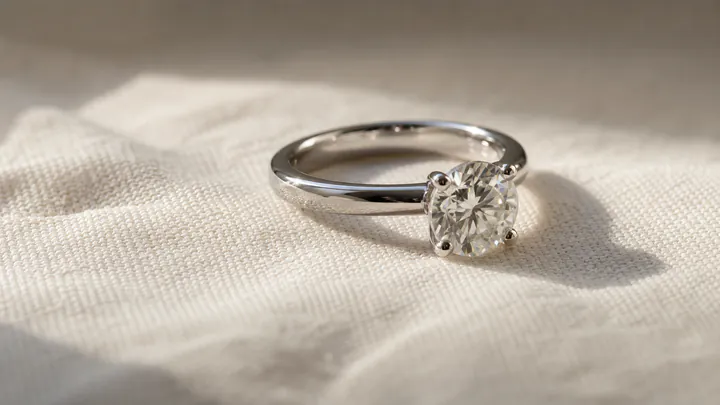
Gold diamond rings South Africa: the metal you pick changes the diamond you should buy
Short answer: pick the gold colour and the diamond colour grade together, and buy the stone from a manufacturer, cutting house or dealer.
- The metal earns back a colour grade. Warm gold reflects its colour up into the pavilion, so a faintly warm H or I reads as deliberate and rich, while a D or E is a premium the metal then masks.
- Cheaper. The counter selling you that finished ring bought the same certified stone at trade level and then roughly doubled the price, about three times at a branded showroom. That gap dwarfs anything a colour grade could save you.
- Better. Premium specification is about five times more common one step up the chain, 52 percent of trade-access stock against 9 percent of retail-held stock.
- They do the gold work too, which matters more on a ring than on anything else. Rings get resized, re-tipped, re-shanked and re-plated more than almost anything people own, and all of that is bench work. Most dealers, manufacturers and cutting houses either run a bench or work with one, so the same place sets the stone, takes a bespoke commission, and handles the repairs and insurance valuations later. A counter without a workshop sends every one of those jobs out to a bench like theirs.
A counter is the better answer when the ring is needed on a date that cannot move, when a dozen finished rings on a real hand is how you want to choose, or when the brand is part of the gift.
Now the detail. Put a face-up colourless D or E stone in yellow gold and you have paid a premium the warm metal then masks. Put a faintly warm H or I stone in the same setting and it looks deliberate and rich. That is the lever, and it works in low-set, bezel and vintage styles most of all, where metal sits closest to the stone.
The search itself is broad. It covers yellow gold solitaires, white gold engagement rings, rose gold dress rings, men’s diamond bands and anniversary eternity rings. They share one rule: in a serious natural diamond ring, the stone is where the money sits and the gold is the frame. Price the diamond first, then the setting. A plain 18ct band is a few thousand rand in metal and labour. The diamond is the five-figure decision.
Yellow gold: the warmth faces up into the stone
Yellow gold is having a real moment in South Africa, and it suits our light. The trade secret is that yellow gold reflects its colour up through the pavilion of the stone, especially in low-set, bezel or vintage-style settings where metal sits close to the diamond. That is not a flaw. It means you can confidently drop a colour grade or two. An H or I natural diamond that might look faintly tinted next to platinum looks completely at home in 18ct yellow, and you redirect that saving into cut, which is what actually makes a diamond come alive.
Ask for the colour grade in writing anyway. You want to choose the warmth, not inherit it by accident.
White gold: crisp, but it is rhodium you are seeing
White gold is still the South African default, and for good reason. It keeps a near-colourless diamond reading clean and bright. What buyers do not realise is that the bright white surface is rhodium plating over an alloy that is actually pale yellow underneath. Rhodium wears. On a daily-wear ring you should expect to re-plate every 18 months to a few years, and it is a small workshop job, not a crisis. If you genuinely never want to re-plate, that is a conversation about platinum, which I cover on the platinum engagement rings page, where density and patina are the honest trade-offs.
In white gold, do not drop the diamond’s cut grade to fund a heavier or more decorative setting. A GIA Excellent cut natural stone in a simple white gold solitaire will out-sparkle a busy ring built around a sleepy stone every time. If you want to see how that plays out shape by shape, the solitaire engagement rings and oval engagement rings pages go deeper.
Rose gold: style-led, and watch the surprise
Rose gold is the most personal of the three. The copper in the alloy gives it its blush, and like yellow it flatters warmer stones. My honest caution is about gifting it as a surprise. If the person already wears white metal every day, a rose gold ring can sit awkwardly against the rest of their jewellery. When the centre stone matters, the same natural-only rule holds: get the GIA report and verify it.
Men’s gold diamond bands: durability first
For a man’s diamond band the priority shifts from colour to wear. Ask about band width, wall thickness, the setting style protecting any diamonds, whether the diamonds are natural, and whether small stones can be replaced down the line. A flush or channel setting survives daily knocks far better than raised claws. If it is a plain gold band with no meaningful stones, ordinary retail is fine. If real natural diamonds are involved, you are back to pricing the stone first.
What gold diamond rings really cost in 2026
There are two numbers worth carrying around, and it matters to be exact about what each one is, because they answer different questions.
The first is a loose stone, and it is arithmetic rather than a survey, which means you can redo it yourself. Rapaport’s round brilliant list dated 20 March 2026 prices G/VS1 in the 1.00 to 1.49 carat bracket at $5,400 per carat. That list is an asking price, so a discount has to be assumed. At 10 to 30 percent off list, R16.50 to the dollar and 15 percent VAT, a one carat G/VS1 loose stone estimates to roughly R72,000 to R92,000 including VAT, with about R82,000 in the middle at 20 percent off. It is an estimate on a published list plus a stated assumption, not a measurement, and every figure in it moves when the list, the rand or the VAT rate moves.
The second is observed. Our July 2026 pricing sample covered 73 rows, 71 of them carrying a price, across 18 sellers, 17 of them South African and one an international online retailer, spanning premium showrooms, mall chains and online sellers. Within it, three premium showroom listings of a finished one carat ring ran R105,000 to R428,000. That number has a setting inside it, and those three listings were three different specifications, so it describes what showrooms charge for “a one carat ring” and is not a like-for-like comparison with the loose estimate above. We publish it as a band rather than as individual stones with prices attached, because one stone and one figure identifies a business while a band describes a market.
Look at the loose estimate on its own for a moment. One colour grade, one clarity grade, one cut grade, and the number still moves by twenty thousand rand, entirely because nobody publishes the discount at which stones actually change hands. Now change the letters. A D flawless and an H VS2 are both sold as “1 carat” and they are nowhere near the same purchase. Carat is the number people quote. Specification is the number that moves. The gold setting on top of any of this is comparatively small. For a fuller picture of how price moves with the four Cs, read our diamond price index for South Africa.
Lab-grown, for completeness, and put carefully because these numbers get exaggerated in both directions. A grown one carat costs a small fraction of the bands above and it has kept falling: the wholesale index the trade watches for grown stones is down about 96 percent since tracking began in July 2018, with the decline slowing through 2026 rather than stopping. Resale is where the difference really shows. Published estimates of what a grown stone gets back are wide and inconsistent, mostly a fifth to two fifths of the purchase price, and a good number of jewellers will not take one in at all. In a gold ring that means the metal keeps a floor under part of what you paid and the grown stone does not, so buy one for the look it gives you today rather than as something to hold.
How the money actually flows, and how to buy well
One more thing worth knowing. With most online sellers the stone is brought in from a much larger catalogue only after you commit. That is not the thing to remember, because ordering in is ordinary and it is how an exact specification gets found. The thing to remember is that on most of those arrangements nobody there opens the parcel. Set our June 2026 inventory count beside that: across 230 GIA-certified natural diamonds listed by six South African sellers, stones reachable through trade access met premium specification, D to G in colour with VS2 clarity or better, 52 percent of the time, against 9 percent of the stock actually held in South African retail. The catalogue is where the good goods are. The counter is where somebody can actually look at them. Neither figure is a price and we are not going to dress them up as one. What they do tell you is that a cheap display-case headline is usually a quietly downgraded stone, and that a sharp online price still has you paying before anyone has seen the diamond.
There is a way to shorten the search itself. Looking for a diamond dealer or a wholesaler turns up very little worth having here, and hardly anyone searches those words in the first place. Search what a one carat diamond costs, or the diamond price per carat in South Africa, and what comes back are the sellers who have chosen to publish a number. On a gold diamond ring that habit is exactly what you want, because a seller who prices per carat will quote the stone apart from the metal without being asked twice.
A gold diamond ring is two purchases sharing one price tag, and that is what makes comparing sellers either very easy or completely pointless. The metal half you can check yourself: karat, mass in grams, the day’s gold price, and everyone lands in the same place. The diamond half you cannot, which is why a single finished-ring figure does so much quiet damage. A keen stone can be paid for by a dear setting inside one number and you will never see it happen. So make everyone split the quote, then run the diamond buying checklist across the stone half only: whether that diamond is in the building, whose report it carries and whether you verified it yourself rather than being read it, and what the return terms say in writing. Do that with two sellers on the same written specification and the gold lines will come back within a few hundred rand of each other. That is the whole trick. Once the metal cancels out, everything left between the two quotes is the stone and the margin, and the sign above the door tells you nothing about either.
When you ask for a quote, from anyone, use this:
Please quote the natural diamond separately from the 18ct gold setting, include the GIA report number where applicable, and confirm natural origin in writing.
If the answer comes back clear and the report checks out on GIA Report Check, you are buying well. With gold diamond rings the winning order never changes: settle the natural stone first, on its own line, then choose your yellow, white or rose gold around it.
Sources and references
- naturaldiamond.co.za inventory study, 230 GIA-certified natural diamonds across six South African sellers, collected 26 June 2026, and pricing sample, 73 rows of which 71 carried a price, across 18 sellers, 17 of them South African and one an international online retailer, July 2026, published as bands.
- Rapaport round brilliant price list, 20 March 2026, G/VS1, 1.00 to 1.49 carat bracket, at $5,400 per carat, used with a stated discount assumption at R16.50 to the dollar and 15 percent VAT.
- GIA Report Check
- GIA diamond education
- Quarterly wholesale price index for lab-grown diamonds, Q2 2026