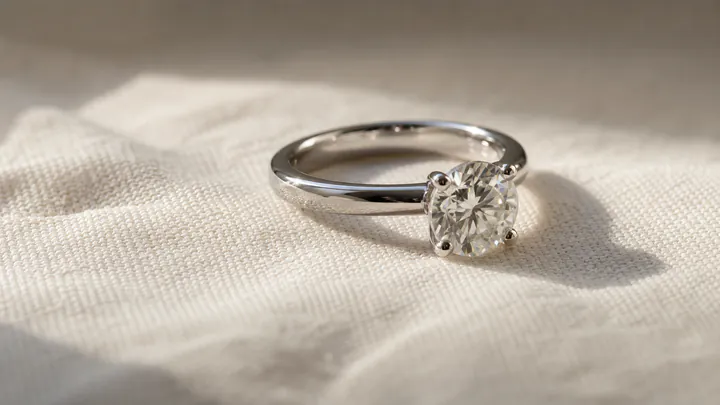
Bottom line up front
Short answer: choose the natural GIA centre stone first, the metal second, and buy the stone from a manufacturer, cutting house or dealer.
- What platinum genuinely buys you. A metal that is naturally white and never needs re-plating, so it still looks right in thirty years when the rhodium on a white gold ring has long worn through. For some buyers that is worth the premium.
- What it does not buy you. A better diamond. The stone is where almost all the money and almost all the regret live, and platinum is not worth it if it forces you down a colour grade.
- Cheaper up the chain. A retailer buys its diamonds at exactly manufacturer, cutting house or dealer level and then roughly doubles the price, about three times at a branded showroom, while the steps between one trade level and the next run at 3 to 5 percent.
- Better up the chain. The colour and clarity you want in a solitaire are about five times more common there, 52 percent of trade-access stock against 9 percent of retail-held stock.
- And that is where the metal work happens. Platinum wants the occasional polish, white gold wants re-plating every few years, and both eventually want resizing and re-tipping. All of it is bench work. Most dealers, manufacturers and cutting houses either run a bench or work with one, so the same place sets the stone, takes a bespoke commission, and does the polishing, resizing and insurance valuations afterwards. A counter without a workshop sends every one of those jobs out to a bench like theirs.
A showroom is the better answer when the ring is needed by a fixed date a few weeks out, when a dozen finished rings on a real hand decide it, or when the label is part of what you want. Ask for the loose stone on its own line either way.
The diamond buying checklist sets out how to tell which kind of seller you are dealing with.
What platinum actually is, in the hand
Platinum is about 30 percent denser than 18ct gold, so the same ring weighs noticeably more. People either love that heft or find it surprising. It is also roughly 95 percent pure platinum in a typical Pt950 ring, against 75 percent gold in 18ct, which is why it sits hypoallergenic on skin that reacts to the nickel and alloys in some white golds.
The patina question is the one the trade rarely explains properly. Platinum scratches more easily than white gold in daily wear, but it does not lose metal when it scratches. The metal is pushed aside rather than shaved off, so an old platinum band thickens into a soft satin grey rather than wearing thin. That grey can be polished bright again at any jeweller. White gold does the opposite: it is harder on the surface, but it genuinely loses tiny amounts of metal over years, and the bright white you see in the shop is a rhodium plate over a slightly yellowish gold alloy. That plate wears off the high points, usually first on the back of the band, and needs redoing every few years. Neither is wrong. Platinum trades a higher upfront cost and the odd polish for never re-plating; white gold trades cheaper metal and lighter weight for that maintenance.
Why platinum suits some stones more than others
A practical point that matters more than the marketing: a four-claw or six-claw platinum setting holds a stone more securely over decades because platinum claws bend less and wear slower than gold claws. For a larger or higher-value natural diamond, that durability is a real argument for platinum. For a modest stone in a simple solitaire, 18ct white gold claws are perfectly safe and the saving is better spent on the diamond.
Colour interaction is the other half. Platinum and white gold both read as cold white next to a diamond, so a near-colourless stone (G to J) looks clean in either. Yellow gold is the one to think twice about, because the warm metal reflects up into the pavilion and can pull a faintly tinted stone visibly warmer, which is fine if you want a warm look and a problem if you paid for an icy one. If you are weighing the white metals against each other, our white gold engagement rings South Africa page covers the rhodium cycle in more detail.
Tie the metal to real numbers, not the showroom
Here is where the metal decision gets put in its place. Start with the stone, using a benchmark you can reproduce rather than a number you have to trust. Rapaport’s round list of 20 March 2026 prices G colour, VS1 clarity in the 1.00 to 1.49 carat bracket at $5,400 per carat. That is an asking price and the trade sells under it, so take 10 to 30 percent off, convert at R16.50 to the dollar, add 15 percent VAT, and a loose one carat G VS1 comes out at roughly R72,000 to R92,000, with about R82,000 in the middle at 20 percent off list. Now the shop end. My July 2026 pricing covered 73 one carat listings across 18 sellers, 17 of them South African, with 71 rows carrying a price, and finished one carat rings at premium showrooms ran R105,000 to R428,000. That second figure includes a setting and rests on three listings of three different specifications, so it is not the same object as the first and must not be read as a saving. Set either of them beside a metal upgrade of a few thousand rand and the point makes itself: against a centre stone that swings by tens of thousands on colour, clarity and cut alone, the metal is not the decision people treat it as. Full workings are in the diamond price index South Africa.
Some of the distance between a loose stone and a finished ring is the setting and the bench work, which are real and have to be paid for. The rest of it is published trade convention rather than anything I uncovered. The retail convention is keystone: the counter price is roughly double what the stone cost the counter, and a branded showroom goes to about three times. Between one level of the trade and the next the margins are thin, commonly 3 to 5 percent a hop. The doubling arrives at the moment a stone leaves the trade for a retail counter, and it pays rent, stock, staff, insurance and a brand. That is not a scandal. It is just worth knowing you are paying it, and worth knowing that no metal upgrade changes it.
What that means for a platinum ring in particular is a stocking problem. In June 2026 we listed 230 GIA-certified natural diamonds across six South African sellers and split them by where the stone was held. Trade access carried D to G colour with VS2 clarity or better on 52 percent of its stones. On a South African retail shelf that figure collapsed to 9 percent. That is a comparison of what is stocked and not of price, but it explains the tidy platinum solitaire in the window: the odds are heavily against the diamond in it being high specification, and the weight and shine of the metal are doing part of the work of making it feel expensive. Price the loose stone on its own before anybody starts talking to you about the setting.
How I would actually buy it
Ask any jeweller for the loose natural GIA diamond priced separately from the setting. Never accept a single ring number, because that is where a thin metal upgrade hides a downgraded stone. Then ask for three quotes on the exact same stone:
- 18ct white gold solitaire.
- Platinum solitaire.
- The platinum solitaire, but on a slightly smaller or lower-colour stone to hit the same total.
Line those up and the metal stops being a feeling and becomes a number. If platinum only costs you a few thousand rand on the same stone, take it for the longevity. If it forces you onto option three and a worse diamond, take the white gold and the better stone. If you want to compare the platinum solitaire against a halo or a three-stone design at the same budget, our solitaire engagement rings South Africa and best engagement rings South Africa pages run the same loose-stone-first logic.
Where I would start for the stone
Start with the price question rather than the metal, and rather than searching for a dealer or a wholesaler, which turns up almost nothing useful in South Africa. Search what you actually want to know, which is the stone price: 1 carat diamond price, or diamond price per carat South Africa. Sellers who work close to the trade tend to publish a rand figure per carat, and the ones who publish it are the ones who will also quote you a loose stone separately from a platinum setting without a fuss. The ones who only publish a contact form generally will not.
Take the three-quote exercise above to each of them and watch what comes back. The diamond buying checklist fills in the rest, and on a platinum ring half the pointed questions are metal questions rather than stone ones. What does the mount weigh in grams of Pt950, because platinum is sold by weight and a heavier shank is simply a bigger number for the same design. Is the making charged as its own line, apart from the metal. Is the diamond in the building or still to be ordered, and does the report number reach you before payment or after it. Is VAT inside the figure or waiting outside it. A seller who answers all five in a single email has told you more about how they trade than any amount of showroom polish, and you got there without needing to know a shop name at all.