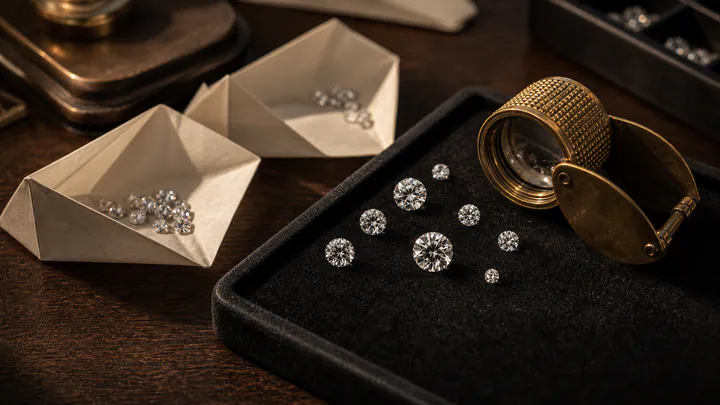
Short answer: get a written GIA-based valuation, then sell to a manufacturer, cutting house or dealer with a bench rather than to a scrap desk or a pawn counter.
- More money, because they have a next home for the stone. A trade buyer prices your diamond as a diamond, since it goes into the next commission or straight back into stock as certified goods. A melt counter weighs the metal and treats the stone as an afterthought.
- Two numbers instead of one. The metal and the diamond come back priced separately, which is the only way to see whether a good natural stone was paid for properly or quietly bundled in at scrap rates.
- They can remake it instead of buying it. Resetting the stone, repairs, resizing, re-tipping and insurance valuations happen on their own bench, so keeping the diamond is a live option rather than a referral. A retail counter mostly sends that work out to a bench like theirs.
- Expect trade value, and expect it well under what you paid. A retail counter buys at trade level and roughly doubles the price, about three times at a branded showroom, and that one step is the bill arriving years later. It is also the plainest argument for buying one step earlier next time.
Sell to a quick-cash or scrap counter instead only if you need the money this week, or if the piece is a worn band carrying melee too small for anyone to re-use, where the difference will be small anyway.
Know what the stone is worth before anyone makes you an offer. On the published round list, a loose one carat round brilliant currently works out to roughly R71,500 to R92,000 including VAT in G/VS1, R60,000 to R77,000 in H/VS1 and R41,000 to R53,000 in I/SI1, with a 0.50 carat G/VS1 at about R12,500 to R16,000: the list less 10 to 30 percent, at R16.50 to the dollar, plus 15 percent VAT. That is what a comparable loose stone sells for, not what you will be offered, and a buyer needs a margin on the resale so the offer will sit below it. The fuller table is further down, and it is the number to negotiate against instead of a percentage of what you originally paid.
A buy-back is a purchase running backwards, so the same test applies, only from the other side of the counter. The diamond buying checklist is written for somebody spending money, but read it against a buyer and every line still does work. Is a person with a loupe actually looking at your stone, or is it being priced off a photograph and a description. Is the GIA report number being checked against the laboratory’s own database in front of you. Is the metal quoted separately from the diamond. Is any of it in writing. Those four answers sort the buyers worth taking seriously from the ones trading on a name you happen to recognise.
If a buyer will not split the number, that alone tells you who you are dealing with, and it tells you before you have handed anything over.
Three different “offers” that look the same
The first is a scrap or melt offer from a gold buyer or a “we buy gold” counter. It is fast and honest about what it is. The metal gets weighed, you get a percentage of the live gold price, and the diamond is treated as an afterthought or ignored entirely. Fine for thin worn bands with tiny stones. Wrong for anything with a real centre diamond. If your piece is mostly metal, my companion guide on selling gold jewellery in South Africa and the notes on gold buyers in Johannesburg cover how that number is built.
The second is a pawn or quick-cash offer. This is a loan dressed up as a sale, or a sale priced like a loan. The number is low on purpose because the buyer is pricing in the risk that you never come back and the cost of holding stock they may not move. You are paying for speed.
The third is a trade buy-back, and it is the only one of the three that prices your diamond as a diamond. It comes from a business that can use the stone again, so the offer is built from what the stone is worth as loose certified goods rather than from what the metal weighs. It is slower, it usually wants the report and the invoice, and it is the number the rest of this page is about.
What a fair buy-back number actually looks like
A fair offer is one you can reconstruct from the parts, and that is the test to apply.
Ask for it broken out: what the stone is worth as a loose certified diamond at trade level today, what the metal is worth by weight, and what, if anything, is being allowed for the making. A buyer working honestly will give you those three numbers without hesitation, because that is how they arrived at the total in the first place. A buyer who will only give you one figure is asking you to trust an arithmetic you cannot see.
Expect the stone line to be trade value rather than retail value, and expect that to be a long way below what you paid. That gap is not the buyer being unfair. It is the retail margin from the original purchase, arriving as a bill years later. It is also the clearest argument there is for buying at trade level next time, because the same stone bought one step earlier would have a far shorter fall.
To get a yardstick for either side of that, work out what your weight and grade sells for as a loose stone right now. That is arithmetic you can do at the kitchen table. Take the published round list for your bracket and grade, knock 10 to 30 percent off it, convert at R16.50 to the dollar and add 15 percent VAT, and for common specifications it lands here:
| Loose round brilliant, incl VAT | G/VS1 | H/VS1 | H/VS2 | I/SI1 |
|---|---|---|---|---|
| 0.50 ct | R12,500 to R16,000 | R11,500 to R14,500 | R10,500 to R13,500 | R8,500 to R11,000 |
| 0.70 ct | R25,000 to R32,500 | R21,500 to R27,500 | R19,500 to R25,000 | R15,000 to R19,000 |
| 1.00 ct | R71,500 to R92,000 | R60,000 to R77,000 | R56,000 to R71,500 | R41,000 to R53,000 |
| 1.50 ct | R187,000 to R241,000 | R153,000 to R197,000 | R139,000 to R179,000 | R106,000 to R136,000 |
| 2.00 ct | R398,000 to R512,000 | R332,000 to R427,000 | R305,000 to R393,000 | R228,000 to R294,000 |
Be precise about what that table is before you take it into a negotiation. It is what a comparable loose stone sells for, not what you will be offered, and it prices a bare round brilliant with no setting, no making and no certification fee in it. A buyer has to make a margin on the next sale, so a fair offer sits below those figures, sometimes well below, depending on how liquid your exact grade is. It is also an estimate on a published asking list rather than a measurement, and it moves with the list and the rand.
What it does is change the conversation. Instead of arguing about a percentage of what you paid, which is a number only you know and only you care about, you are discussing a discount off a stated current value for that specification. Any buyer who will not put a current per-carat number next to their offer is asking you to accept a discount off a price nobody has stated. Sellers who publish a per-carat figure in public are the ones you can cross-check, so search the price question for your grade rather than hunting for a dealer by name.
The paperwork is the price
I cannot say this strongly enough: the document is the difference between a guess and a quote. With a GIA report in hand, the buyer knows exactly what they are buying and can price it tightly. With no report, they have to assume your colour and clarity are worse than you hope and build a cushion in, and you wear the cost of that caution.
Sell the piece, or keep the stone and remake
There is a second route people forget. If the centre diamond is good, you do not have to sell the whole item at all. You can keep the stone and reset it, which means you only “pay” the buyer’s margin on the metal and the making, not on the diamond. For an inherited ring with a strong natural centre stone, that is often the better financial answer as well as the sentimental one, and I have written separately on how to sell a diamond ring in South Africa and on resetting and repurposing a diamond ring in Johannesburg when a remake makes more sense than a sale.
The route I trust first
Take the piece to a buyer who can use the stone again, rather than one who has to flip it. A cutting house, a manufacturer or a diamond dealer with a bench has a next home for a good natural diamond: it goes into the next commission, or straight back into stock as certified goods. A counter that only resells finished jewellery has to find one retail buyer for your exact ring, which is slow and uncertain, and the offer will carry the cost of that uncertainty. Same stone, two different businesses, two very different numbers.
Then there is the lesson a buy-back teaches better than any buying guide, and it is worth sitting with for a moment.
The figure you are offered is, near enough, trade value. It is what your diamond is worth to somebody who will handle it professionally and move it on. Put that number beside the original till receipt and you are finally looking at an old decision, itemised. A retail jeweller’s supplier is a dealer. The jeweller bought the certified stone at trade level and added a margin, and trade convention is keystone, meaning the counter price is roughly double the cost, with branded showrooms running to about three times. Between one trade level and the next the margins are thin, roughly 3 to 5 percent a hop. So most of the gap between what you paid and what you are now being offered is not the diamond having lost value. It is that single last step, arriving as a bill years later.
That is not a reason to feel swindled. The margin bought a showroom, stock on a shelf, staff, insurance, a brand and the ability to walk out with the ring the same afternoon, and plenty of people would pay it again with their eyes open. But it is the clearest argument there is for the next purchase. If the diamond is the part that holds value, buy the diamond at the level you are now being asked to sell it at, and pay a jeweller separately and properly for the setting and the making. The chain is set out in full in what a diamond costs in South Africa, and diamond dealers versus retailers covers which of them will deal with the public.
Three checks before you accept anything:
- Ask each buyer where the stone goes next. A trade buyer with a bench answers straight away. A counter that has to find a retail buyer will be vaguer, and the offer will show it.
- Get the metal and the diamond as two written numbers, every time. A single lump sum is exactly where a good natural stone gets paid for at scrap rates.
- Get your second offer from a different level of the trade rather than from another counter of the same kind. Two offers from the same layer tell you almost nothing.
Sources and references
- naturaldiamond.co.za July 2026 retail price study, 73 listings across 18 sellers of which 17 are South African, 71 of the rows carrying a price, published as bands only
- Rapaport round brilliant price list, 20 March 2026, G/VS1 at 1.00 to 1.49 carats, 5,400 US dollars per carat
- GIA Report Check
- Jewellery Council of South Africa
- South African Diamonds and Precious Metals Regulator