Bottom line up front
Short answer: choose the natural GIA diamond first, at manufacturer, cutting house or dealer level, and design the ring around that exact stone.
- Cheaper. A retail studio buys its centre stones at that same level and then roughly doubles the price, about three times at a branded showroom. The centre stone is 70 to 85 percent of a custom budget, so that single hop decides most of the bill.
- Better. The specification a custom brief usually calls for is about five times likelier to sit in trade-reachable stock than in a display case, 52 percent against 9 percent.
- They do the making and the looking after. Most Johannesburg dealers, manufacturers and cutting houses either run a bench or work with one, so the same business takes the commission, sets the stone, and later resizes, re-tips and re-values the ring it built. A studio without a bench sends that work out to one of theirs.
- Johannesburg is the easy place to do it. A working cutting and dealing trade sits here alongside the counters, and GIA runs a laboratory in the city, so a stone can be cut, graded and sold inside a short documented local chain.
A studio with finished stock is the better answer when the date will not move, when you want a wall of completed rings on a real hand rather than a drawing, or when the name and the box are part of it. A commission arrives weeks later, because it is made to order.
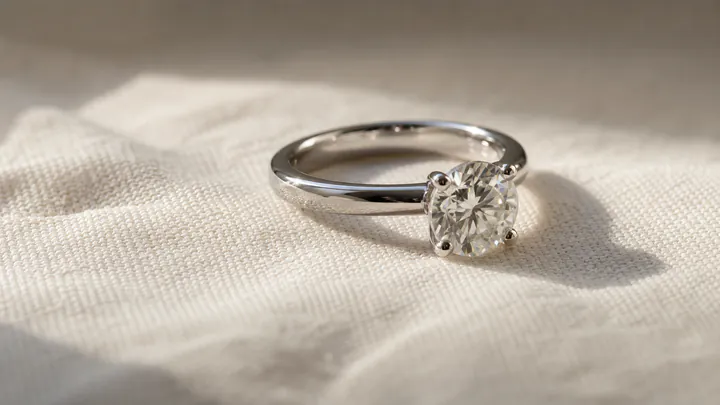
Walk into most Johannesburg studios for custom engagement rings and you will be shown settings first, sketches and metals and shoulder styles, as if the ring is the decision and the diamond just slots in. It is the other way round. The centre stone is roughly 70 to 85 percent of what you will spend, and unlike the setting, you cannot redesign it later. Lock its specification and report number before a single line of CAD is drawn.
For genuine custom work, the ring should be built around a real diamond you have inspected, not a catalogue photo, yet most Johannesburg sellers will not show you the loose stone before the design starts. Sourcing one in for you is fine, and on a bespoke brief it is often necessary. What is not fine is designing a setting around a diamond nobody has held. Johannesburg does carry one real advantage here: GIA runs a South African laboratory in the city, so a stone can be cut, graded and sold inside a short and documented local chain, and it is possible to sit with the person who cut it before any CAD work begins. Treat that as provenance and convenience rather than a grading advantage, because GIA grades to a single standard wherever a stone is submitted. The diamond buying checklist sets out the questions that establish whether a given studio can actually put the stone in your hand.
Custom engagement rings Johannesburg: start at the stone
Here is the order I would follow, and it is deliberately stone-first.
- Decide the centre-stone spec and a hard ceiling for it.
- View the actual GIA-certified natural stone in person and verify the report.
- Only then brief the setting: metal, style, timeline, after-care.
The reason custom buyers get burned is that the romantic part, the setting, is easy to sell and easy to upsell. The expensive, permanent part, the diamond, is where you should spend your scrutiny. Get the stone right and an ordinary solitaire looks extraordinary. Get the stone wrong and no amount of micro-pavé rescues it.
Cut comes before carat, every time
If you only screen one thing, screen cut. A GIA Excellent cut on a round brilliant is what makes a diamond return light and look bigger than its weight. I would rather have a well-cut 0.90 carat than a sleepy, over-deep 1.05 carat that leaks light through the bottom. For a custom ring this matters even more, because you are choosing the loose stone yourself rather than accepting a pre-set one. Insist on GIA Excellent cut for round brilliant, and ask to see the stone face-up next to its report.
What the real Johannesburg numbers say
In June 2026 I listed 230 GIA-certified natural diamonds offered by six South African sellers, with each stone’s specification recorded next to it. Premium specification here means D to G in colour and VS2 or better in clarity, which is roughly what people picture when they say they want a good stone. The split by where the diamond was sitting is stark.
| Where the stone sits | Stones listed | Share at premium specification |
|---|---|---|
| Reachable through trade access | 93 | 52 percent |
| Held in South African retail stock | 137 | 9 percent |
Read that before you compare custom quotes, and read it for what it is. It measures what is available, not what anything costs. Roughly half of what the trade can reach will satisfy a high-colour, high-clarity brief. Fewer than one in ten stones sitting in South African retail will. So when a mall quote comes back cheaper for what sounds like the same ring, the likeliest explanation is not a better deal, it is a stone a grade or two down, which on a custom build you will be looking at for the next forty years.
The order-in question sits alongside that one, and on a bespoke brief it matters more than it does on a finished ring. Much of what is advertised here is sourced on demand from a global feed after you commit. Drawing on that feed is how an exact specification actually gets found, so it is not a fault in itself. The fault is designing an entire ring around a diamond nobody local has held, where the first person to look at it closely is the setter about to put it under pressure.
Price, separately, and it is a different kind of evidence. In July 2026 I recorded 73 listings, 71 of them carrying a price, across 18 sellers, 17 South African and one an international online retailer. At one carat, a finished ring in a premium showroom ran R105,000 to R428,000. That band comes off three listings of three different specifications and it includes the setting, so it tells you the range of what a showroom charges for a one carat ring, not what one particular stone costs in three places.
For the stone alone I would not lean on anyone’s observed band, mine included. I would do the arithmetic. Rapaport’s round list for 20 March 2026 puts G/VS1 in the 1.00 to 1.49 carat bracket at $5,400 per carat. A carat of that, less a dealer discount, converted at R16.50 to the dollar and grossed up by 15 percent VAT, gives roughly R92,000 at 10 percent off list, about R82,000 at 20 percent off, and roughly R72,000 at 30 percent off. Loose stone, no setting, and an estimate rather than a measurement, but one you can redo in a minute when the list or the rand moves.
Hold the difference between those two things in your head, because one is a finished ring and one is a bare diamond. What sits between them is mostly the published mark-up convention rather than the diamond: a retail counter works on keystone, roughly double the trade cost, a branded showroom goes to roughly three times, and the steps between one trade level and the next are commonly 3 to 5 percent. Custom is one way of buying nearer the trade end of that chain, which is the whole financial argument for doing it.
So sanity-check a centre-stone quote on the specification, not the total. Ask for carat weight, colour, clarity, cut grade and the GIA report number, then a price per carat with VAT stated, and compare only quotes that match on all of it. Colour and clarity move the price far more than weight does, which is why a vague quote for a one carat ring tells you almost nothing at all. Our full diamond price index for South Africa has the workings behind the numbers above.
The setting brief: where custom earns its keep
Once the stone is chosen, the setting is where custom pays off, because you control scope. A written brief should separate, as distinct line items: the natural diamond and its GIA report number, the metal, the labour, the design and CAD work, the setting style, the timeline, and the after-care terms. If a quote hands you one lump sum, you cannot tell whether you are paying for the diamond or the goldsmith’s overtime.
A sensible starting point for most Johannesburg custom rings:
| Decision | Sensible first choice | Upgrade if budget allows |
|---|---|---|
| Centre stone | Natural GIA, G to H colour, VS2 to SI1 clarity | Higher colour or clarity |
| Cut | GIA Excellent on round brilliant | Stronger light-performance screening |
| Metal | 18ct white or yellow gold | Platinum |
| Setting | Solitaire or simple hidden halo | Full custom halo or three-stone |
| Process | Written quote plus one CAD round | CAD plus extra design rounds |
Metal is worth a plain word. 18ct white gold needs rhodium re-plating every year or two and platinum does not, which is the real long-term cost difference, not the day-one price. If you want the detail, our white gold engagement rings guide covers the upkeep honestly.
Using your own or an inherited diamond
One of the best reasons to go custom in Johannesburg is to reset a family stone, but do not hand it over on a handshake. Before any design starts, get in writing: the carat weight and measurements, the condition including any chips, abrasions or setting risk, whether the stone has a report or needs one, who carries insurance while it is out of your possession, and the exact resetting plan. A reputable workshop will document all of that without being chased. If anyone is vague about insurance or condition, that is your answer.
Custom does not mean an open chequebook
Custom can be the smartest way to buy or the most expensive, and the difference is scope control. Cap the setting brief before you start, put your money into the centre stone, and treat extra CAD rounds as a deliberate upgrade rather than a default. If you are resetting because you want a bigger or better stone later, read our note on how to upgrade an engagement ring in Johannesburg so you do not pay twice for the same setting.
Where I would actually go
Start with a search that works. Johannesburg buyers reach for diamond wholesalers Johannesburg or diamond dealer, and it is close to a dead end: those terms carry almost no search volume here and the results are not the studios and trade-level sellers this page is about. Search the price question instead, 1 carat diamond price or diamond price per carat South Africa, and look for who publishes an actual per-carat number rather than an enquiry form. On a custom brief that number is the exact line item you will be negotiating, so a seller who has already put it in public has done half the conversation for you.
With the shortlist built, the diamond buying checklist is what you carry from studio to studio, and on a bespoke brief the order of the questions is half the value. Ask about the centre stone before you discuss a single design detail. Is it in the building today. Does its report number reach you before the deposit rather than after the casting. Does it sit on the quote as its own line instead of being folded in with the CAD and the bench hours. Then ask the question people forget: what happens if you see it and say no. Once a stone is set into a design made for that stone alone, nothing about the arrangement is easy to unwind, so the answers worth having are the ones you get while the diamond is still loose. Which studio it is has nothing to do with it.
A natural-only note
This site recommends natural stones for an engagement ring, and that is a stated preference rather than a finding I can hand you as settled fact. The reasoning behind it is narrow. Lab-grown prices have fallen steeply and continue to fall, the secondhand market for them is thin, and a custom ring is the one purchase where that combination is most likely to matter, because the centre stone is the part people plan to upgrade later. So if a quote leads with a lab-grown centre, ask for the natural comparison at the same specification before you sign anything, and make the call with both numbers in front of you rather than one.