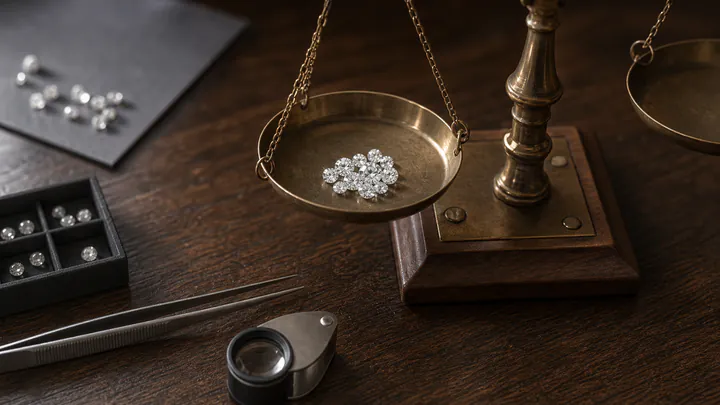
Short answer: if there is a diamond in it, take it to a manufacturer, cutting house or dealer, not a gold counter.
- They pay for the stone. A melt counter has no channel to resell a diamond, so it pays for grams and rounds the stone to a cautious nothing. A dealer can place it, so it prices it.
- They can read what it is. Your offer rests on colour, clarity and cut, and that is the level that trades on those letters every day. A scale cannot see any of them.
- Buy one step earlier next time. A retail counter buys its stones at exactly that trade level and then roughly doubles the price, about three times at a branded showroom. That single doubling is most of the gap you are about to feel.
- They do the rest too. Remaking, resetting, resizing, insurance valuations, repairs and buy-back, usually on their own bench, so selling outright is not your only option once you are there.
Walk straight into a gold buyer instead if you are selling a plain broken chain, a single odd earring, low-karat scrap or bullion, or if you need cash today more than you need the best number. On those a gold counter is quick, fair enough, and exactly the right call.
The scale of what is at stake is the reason to bother. The few grams of 18ct gold holding your stone are worth somewhere between two and five thousand rand on the day. A loose one carat G/VS1 works out at roughly R72,000 to R92,000 including VAT on the published trade list: $5,400 per carat on the Rapaport round list of 20 March 2026, less 10 to 30 percent, converted at 16.50 rand to the dollar with 15 percent VAT added. Nobody is going to hand you a buying figure for a second-hand stone, and this page will not pretend they might. The order of magnitude is the point.
The moment you slide a ring across a Johannesburg gold counter, the assistant does one thing: they pop the stone out of view, drop the metal on a scale, and read off grams against the day’s gold price. That single motion decides your offer, and it is why most gold buyers in Johannesburg quietly leave the most valuable part of your ring out of the maths. So when you search gold buyers Johannesburg with a diamond ring in your hand, understand what you are actually carrying. The metal is the small part. The stone is where the money is, and the stone is the part a melt-only counter is least equipped to pay you for.
That is the whole tension on this page. A gold buyer’s business is weight times purity times the gold price. They are good at that, and for a broken chain or a single odd earring they are exactly who you want. But a natural diamond has no place on their scale, because they have no channel to resell it. So they either ignore it or offer you a cautious round number that has nothing to do with what the stone is worth.
Before you go anywhere, insist that the piece is priced in two parts. Ask every buyer to quote the gold and the diamond as separate lines, the gold against the day’s price per gram and the diamond against a written specification of carat, colour, clarity and cut. A buyer who will not split the quote has told you something useful: they are pricing the metal and rounding the stone to nothing. Get at least two of those split quotes before you agree to anything.
What a melt-only quote really pays you for
A gold buyer in Johannesburg prices three things and ignores a fourth:
| What they price | What it depends on |
|---|---|
| Gold value | Weight in grams, karat purity, the day’s gold price |
| Refining margin | Their cut for melting and reselling the metal |
| Convenience | How fast you want the cash |
| Diamond value (ignored) | Natural origin, carat, colour, clarity, cut, GIA report, resale demand |
The first three are real and fair enough. The problem is the fourth row. A natural diamond can be worth several multiples of the gold around it, and a scrap counter has no way to monetise it, so it falls out of the offer. You walk away paid for the easiest part to melt and nothing for the part that holds the value.
You can defend against this with one calculation before you leave the house. Weigh the piece in grams. Work out the purity: 9ct gold is 37.5 percent pure, 14ct is 58.5 percent, 18ct is 75 percent. Multiply grams by purity by the current gold price per gram. That is your melt floor. A fair gold buyer lands close to it. Anyone offering well under that number, while waving away the diamond, is quietly taking both.
Why the diamond gets undervalued, and how to stop it
Specification drives diamond value far more than size does, and a melt counter cannot read specification. Our June 2026 inventory count describes the market your stone would be going back into: across 230 GIA-certified natural diamonds listed by six South African sellers, 9 percent of the stock actually held in South African retail met premium specification, meaning D to G in colour with VS2 clarity or better, against 52 percent of what sellers could reach through trade access. A buyer who can read a report knows within seconds whether your diamond sits in that scarce top band or in the rest of the market, and offers accordingly. A scale cannot tell the difference, so a scrap counter either assumes the worst or leaves the stone out of the sum entirely. Colour and clarity are the whole argument, and they are invisible to weight.
This is also why a lab-grown stone complicates a sale, and it is worth being exact about why rather than sweeping. Lab-grown prices have not drifted down, they have collapsed: the wholesale index the trade watches for grown stones is 96 percent below where it stood when tracking began in July 2018, and while the rate of fall eased through 2026 it has not turned. Second hand, the market is thin rather than absent. Published estimates of what a lab-grown stone recovers vary widely, mostly landing somewhere between a fifth and two fifths of what was paid, and a good number of counters will not take one in at any price because they have nowhere to place it. Read that as it is: a lab-grown stone is worth what it is worth on the day, not what the original invoice says, and it was never a store of value. If your ring is natural, you need a buyer who can prove and price that, because the difference in your pocket is enormous. The only way to settle it is paperwork and a buyer who reads it.
So before you sell, get a written valuation that names the diamond’s carat, colour, clarity and cut, ideally tied to a GIA report. A verbal “looks like a nice stone” is worth nothing. A written, GIA-based number is what turns a lowball into a negotiation. I walk through the valuation step in detail in the sell a diamond ring guide, and the same discipline applies to any gold jewellery sale where stones are involved.
Cash, trade-in, and buy-back are not the same deal
People say “selling” as if it is one transaction. In practice you are usually choosing between three:
- Outright cash. Fastest, lowest. A gold buyer or pawn-style counter pays you a discounted number and resells. Fine for plain gold, weak for diamonds.
- Trade-in or credit. A jeweller takes the piece against something new. The headline can look generous but it is often padded into the price of the replacement, so compare it against a cash number on the same stone.
- Buy-back. The house that made or sold the piece takes it back on a stated formula. It is usually the strongest number where a diamond is involved, because that buyer already has somewhere to place the stone, but it only exists if you bought somewhere that offers one. Ask what percentage it pays, whether it is in writing, and whether it covers the stone, the setting or both.
Why a cutting house first when there is a diamond
A gold buyer is in the business of metal. That is not a criticism, it is the trade they are in, and for a chain or a broken band they are exactly the right call.
The problem arrives when a diamond is set into what you are selling. A metal buyer prices the gold by weight and treats the stone as an inconvenience to be deducted or ignored, because they have no channel to sell a loose certified diamond and no reason to carry one. So the stone, which is usually most of the value, gets valued at close to nothing.
A cutting house or dealer has the opposite position. They can place a loose stone, so they have a reason to price it properly, and they can weigh the metal alongside it. Take a diamond-set piece there first, get the stone and the gold quoted as two separate lines, and only then decide whether a metal buyer beats it on the gold alone. It costs one extra appointment and it is frequently the difference between two numbers that are not close.
When a gold buyer is genuinely the right call
None of this means avoid gold buyers. For the right item they are the sensible, quick choice:
- Broken plain chains and bracelets with no stones.
- Single earrings or odd pieces with nothing to certify.
- Low-karat scrap and bent, unwearable bits.
- Coins, bullion, or raw gold.
Sources and references
- Natural Diamond inventory study, 230 GIA-certified natural diamonds across six South African sellers, collected 26 June 2026, and Natural Diamond pricing sample, July 2026: 73 rows of which 71 carry a price, across 18 sellers, 17 of them South African and one an international online retailer, published as bands.
- Rapaport round brilliant price list, 20 March 2026: G/VS1 in the 1.00 to 1.49 carat band at $5,400 per carat, used for the loose stone arithmetic on this page. Converted at 16.50 rand to the dollar on 4 August 2026 with 15 percent VAT added. The discount off list is a stated assumption, not a measurement, and none of it is an offer anyone will make you for a used stone.
- GIA Report Check
- the Diamond Dealers Club of South Africa
- South African Diamonds and Precious Metals Regulator