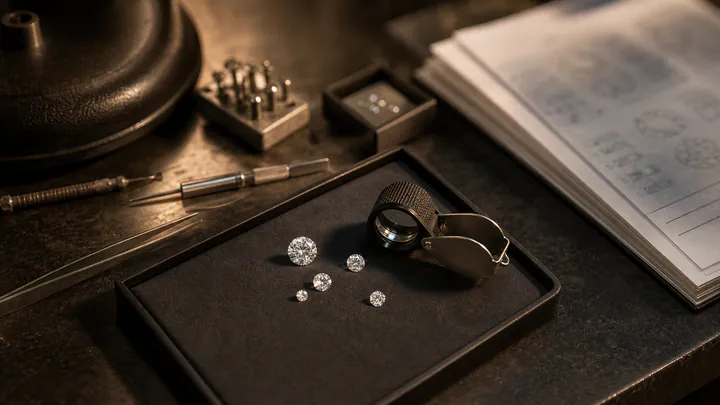
Short answer: ask three questions before you pay. Who cut this stone, who in this building has physically had it in hand, and may I see it before any money moves.
- Those three answers are the whole test. A seller who can give all three can trace your diamond. A seller who cannot is offering a story rather than a record, however warm the sourcing page reads.
- Origin points where price points: a manufacturer, cutting house or dealer. The chain is short enough there to check end to end, and in South Africa it is the only route where the cutting itself may have happened locally, which is the part of ethical this country can genuinely offer.
- Cheaper there as well. A retailer buys its stones at exactly that level and then roughly doubles the price, about three times at a branded showroom. It also inherits the origin gap along with the stone, because nobody at the counter has met the cutter.
- They do the rest too. Setting, bespoke commissions, resizing, re-tipping, insurance valuations, repairs and buy-back, usually on their own bench, and a bench that built the piece can still tell you what is in it years later.
Use a shopfront when the ring is needed by a fixed date, when completed pieces on a hand are how you decide, or when the brand matters to you. Take the seven questions further down this page in with you. A checkable origin claim is not the private property of one kind of seller. It is simply easier to check at one end of the chain than the other.
Notice what the test is not. It is not whether the seller owns the stone. Sourcing a diamond to order is ordinary, most of the trade runs on it, and a dealer with real trade access will find you a better stone than a display case ever will. What decides the question for ethical natural diamonds South Africa is how close to the diamond the seller actually stands. Someone who has never had the stone in hand cannot tell you where its rough came from or who polished it, and that distance is the crux of the ethics problem. It is also the part the glossy sourcing pages leave out.
The Kimberley Process tells you less than you think
Almost every South African seller will point to Kimberley Process compliance as proof of ethics. It is worth understanding exactly what that buys you. The Kimberley Process certifies rough diamonds at the point of export, country by country, to keep conflict goods out of the legal supply chain. It works at the level of shipments and borders, not individual stones.
By the time a diamond is cut, polished, set, and sitting on a counter in Sandton, the KP certificate stayed behind with the rough parcel. It does not travel with your stone, and it says nothing about cutting-house labour, environmental impact, or whether the price is fair. The entire legal trade already meets it. So when a seller leads with Kimberley Process compliance as their ethics headline, they are telling you they clear the floor, not that they have done anything above it. Useful as a baseline, weak as a differentiator.
Four ways of buying, ranked by how traceable they actually are
South African sellers arrange themselves into four broad ways of working, and ethics tracks traceability far more closely than it tracks anything a sourcing page says about itself. What follows is a description of how the trade is put together, not a measurement of it. Here is the honest version.
A budget local retailer posts the cheapest sticker. Our June 2026 inventory count is worth knowing before you are tempted by it: of the stock actually held in South African retail, 9 percent met premium specification, meaning D to G in colour with VS2 clarity or better, against 52 percent of what sellers could reach through trade access. A cheap headline is usually a lower grade rather than a better buy. On ethics, though, the problem is neither the price nor any malice. It is distance. These stones arrive as already-finished goods, and the shop genuinely cannot tell you who cut it or where the rough came from.
A large online seller that orders to order reaches far better goods than any display case, and that is a real advantage rather than a trick. Ordering to order is not the failing; it is simply how stones get found. The failing is where the trail goes cold. The diamond sits in a far larger offshore catalogue until you pay, ships in unopened, and the origin question dead-ends at “a supplier we work with”. Nobody here has handled it, so nobody here can tell you who cut it, and on ethics that is the whole matter.
A cutting house that buys rough and holds its own stock is the only one of the four where the ethics claim is checkable end to end. The house bought the rough, cut it to its own standard, and holds the actual GIA-certified stone you can walk in and inspect. The value-add, the beneficiation and the jobs stayed in South Africa, and you are talking to the person who made the diamond. What that does not tell you is the price, and this is worth being blunt about: we are not going to claim our own figures show this route is cheaper per carat, because they do not show it. A short chain and a low price are different arguments, and the one being made on this page is the short chain.
Pure resellers and marketplaces are the fourth type, and they are the least traceable of all, a stone passed through several hands with no single party accountable for it.
The pattern is uncomfortable but consistent: the more ethical-sounding the marketing, the further the seller usually stands from the actual stone. And a “cheap ethical diamond” is almost always a cheaper stone rather than a cleaner one, because what the price is tracking is specification, not conscience.
Beneficiation is the part of “ethical” that is genuinely South African
There is one ethics dimension where South Africa offers something most countries cannot, and it rarely gets explained. Beneficiation means rough mined here is cut and polished here rather than only shipped out raw, so the skill, the margin, and the jobs stay local. A diamond finished in a Johannesburg cutting house carries a real local-value story you can point to. A retail stone sourced as already-polished offshore goods does not, however ethical the website copy reads.
This is why where the stone was finished matters as much as where it was mined. If local impact is part of why you are buying ethical, ask the seller a blunt question: was this cut in South Africa, and can you show me the house that did it. Most sellers cannot. A cutting house can. Our GIA-certified diamonds guide covers how to confirm the grading itself once you have the origin answer.
The honest verification checklist
Ethics becomes real when it turns into paperwork and inspection, not adjectives. Before you pay, work through this:
- Do you own and hold this exact stone, or are you sourcing it in. This one question sorts the four ways of buying above.
- What is the GIA report number, and can I verify it on GIA Report Check before paying.
- Was the diamond cut or polished in South Africa, and by whom.
- Can I inspect the actual stone in person before money changes hands.
- Is the natural origin stated in writing on the invoice.
- Is the loose-stone price separated from any setting cost, with VAT and any import shown.
- Who is accountable later for checking, resizing, or a buy-back.
If a seller can answer one and four with a yes, most of the ethics question answers itself, because you are dealing with someone who has the stone in hand. If they dodge those two, the rest of the sourcing language is just decoration. The same discipline runs through our wider guide to the best place to buy diamonds in South Africa, and it holds whether you buy from a cutting house or anyone else.
How to find a seller who can answer all seven
This site names no businesses, so what is useful here is a method rather than a shortlist.
The chain that survives every question above is the short one: rough bought, cut locally, and the GIA-certified stone held where you can walk in and look at it. Finding that seller is harder than it should be, largely because most people search for the wrong thing. Looking for a diamond dealer, or for diamond wholesalers in Johannesburg, returns very little of use and almost nobody searches that way in the first place. Ask the price question instead. What a one carat diamond costs, or what a diamond costs per carat in South Africa, is where the country’s diamond searching actually happens, and it surfaces the sellers willing to publish a per-carat number. A seller who publishes one has already accepted being compared on it, and in practice that is the same seller who answers question one and question four without hedging. Take the seven questions to whoever comes back, and use the diamond buying checklist to keep the wording identical from quote to quote.
Then judge what you are handed. Traceability, not the sticker, is what you are buying when you buy on ethics, and it is the one thing you can verify for yourself before any money moves.
If lab-grown is on your mind for ethical reasons, read our natural versus lab-grown comparison before deciding, and if resale matters to you, the investment-grade natural diamonds guide is the honest place to start. The full pricing picture behind all of this sits in our South African diamond price index.
Ethical buying in South Africa is not about finding the seller with the warmest sourcing paragraph. It is about finding the one who can put the actual stone, the GIA number, and the local cutting story in front of you, and let you check all three before you pay.