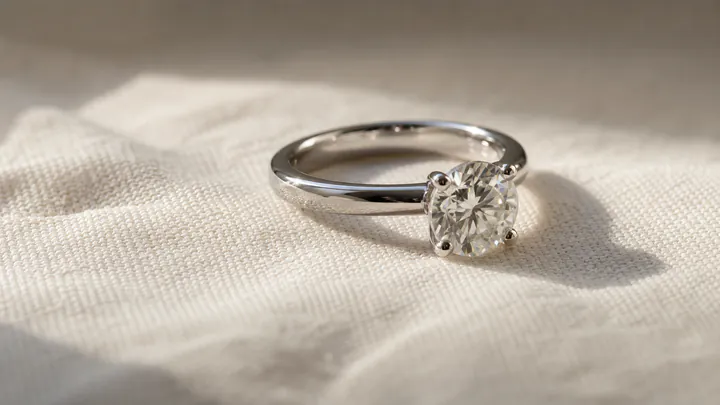
Stand in almost any South African mall and you can walk from an American Swiss window to a Sterns one in under a minute, often without leaving sight of the first cabinet. That short walk is the whole secret: both chains sit under the Lewis Group, run on the same retail-account model, and stock from overlapping suppliers. So when buyers ask me to settle American Swiss vs Sterns engagement rings South Africa, I have to start by deflating the question. The two signs over two shopfronts in the same mall are far more alike than the ring inside either cabinet is to the ring in the cabinet next to it. The real variable is the stone, and the stone is where the money goes.
American Swiss vs Sterns engagement rings: the honest difference
On positioning, there is a small, real gap. American Swiss skews slightly more affordable and casts a wider net across watches, fashion jewellery and gifting, with engagement as one category among many. Sterns leans a touch more traditional and bridal, and has historically pushed the engagement-and-wedding story harder. In practice, walk both floors on the same afternoon and you will see similar price bands, similar account offers, and similar finished rings. Neither chain is a scam. They are convenient, they are everywhere, and an account makes a small ring easy to take home.
What the brand badge does not tell you is the one thing that matters: the grade of the diamond. Two chain rings at the identical sticker price can carry very different colour, clarity and cut. One might be a tidy near-colourless stone with a sharp cut, the other a tinted, slightly included stone that simply faces up similar under shop lights. You cannot see that difference across a glass cabinet. You can only read it off a certificate, and on smaller centre stones the chains often have no independent certificate to give you.
The centre stone is most of what you pay for
In an engagement ring, the diamond is usually 70 to 85 percent of the spend. The metal and the setting are the smaller part. That is why I push every buyer past the storefront question and onto the four Cs, and specifically onto cut first.
Cut is the one C that decides whether a diamond actually returns light, and it is the one chains discount most quietly. A GIA Excellent cut grade on a round brilliant is the floor I would accept. Below that, a stone of the same carat, colour and clarity looks duller in the hand, and you are paying carat weight for sparkle you do not get. After cut, set a colour floor around G to H, which reads white in a ring without paying for the invisible top of the scale, and a clarity floor around VS2 to SI1, which is eye-clean to a normal buyer. Then, and only then, look at carat.
And insist on a GIA report number for the actual stone, not an in-house grading card. You can verify any GIA report yourself at gia.edu/report-check. If a chain salesperson cannot give you a number for the diamond in front of you, you are buying an ungraded stone on trust.
What the real per-carat data shows
This is where our own primary research changes the conversation. In June 2026 we harvested 292 real natural GIA diamonds across seven South African sellers and compared like-for-like consumer prices, VAT included. The pattern that came out is the single most useful thing a ring buyer in this country can know.
- Budget local retail, the category the mall chains live in, came in at about R19,558 per carat. The headline looks cheap, but only around 26 percent of that inventory was high spec. The low price is usually a downgraded stone, lower colour and lower clarity, dressed up in a nice setting.
- Large online sellers that source on demand sat at about R22,678 per carat, with roughly 82 percent of stock high spec. The catch there is different: they do not hold the stone. They source it, they do not stock it, pulling it from a much larger external catalogue and shipping it in, so you pay before you ever see it.
- A cutting house that holds its own GIA-certified stock sat highest, at about R32,844 per carat. That is the most expensive sticker, but it buys the highest spec and a stone you can hold and inspect before a cent changes hands.
Read those three numbers together and the chain “saving” mostly disappears. You are not paying a low price for the same stone. You are paying a fair price for a lesser stone. The honest comparison is not American Swiss against Sterns. It is a downgraded mall stone against a graded stone you can actually see, and our full method is laid out in the South African diamond price index.
Real anchors so you can sanity-check any quote
Spec drives price far more than carat alone. From the same study, a 1.01 carat H VS2 natural diamond was R57,691 ex-VAT, and a typical 1.00 carat F VS1 sits around R72,000 to R80,000 ex-VAT. Push the spec up and the jump is steep: a 1.01 carat E IF was R157,964 and a 1.03 carat D VVS1 was R165,294. So if a chain quotes you a “one carat” ring well under R40,000 including VAT, that is not a bargain on a top stone. It is the price tag of a meaningfully lower grade, which is exactly what you would expect from that 26-percent-high-spec budget pool.
One more anchor, because it comes up at every counter: lab-grown. A lab-grown one-carat now runs around R10,000 and has fallen roughly 90 percent since 2016, with resale near zero. It looks identical in the cabinet. It does not hold value like a natural stone. Chains increasingly mix lab-grown and natural in the same display, so always confirm origin in writing before you pay.
Setting and budget strategy
Where the chains are genuinely useful is style scouting. Walk both, photograph the silhouettes you like, learn the difference between a solitaire, a halo and a trilogy, and clock which metal suits the wearer. That homework costs nothing.
Then split the decision the way the trade does. Price the loose certified diamond separately from the setting. A setting is a known, modest cost. The diamond is the asset. When the two are bundled into one cabinet price, you lose the ability to see whether you are overpaying on the stone, and that is precisely where margin hides. If you want the diamond chosen and graded first and the ring built around it, that is the custom engagement ring route in Johannesburg, and it is also why a buy-back or upgrade path matters later, which I cover in the guide to upgrading an engagement ring in Johannesburg.
For the stone itself, the route I trust first is a cutting house that holds its own stock. Prodiam sits inside De Beers DBCM’s diamond beneficiation programme, which is how it draws its rough straight from the source rather than buying polished off a list, then polishes that rough in its own Bedfordview workshop to a GIA Excellent make it calls ProCut, and keeps the finished GIA-graded naturals on its own shelves. You book a time, inspect the actual stone with the person who cut it, see the loose-diamond price on its own, and there is a buy-back. It is not the cheapest option and I would never sell it as cheapest. It is the best value for the best quality, because the cheaper paths are either a downgraded stone or a stone you never see. You can browse the held stock on the Prodiam loose diamonds page before you commit to anything.
How to compare any two quotes fairly
Send every supplier, chain or cutter, the identical brief and make them answer it in writing.
Please quote a natural 1.00 ct round brilliant, G to H colour, VS2 to SI1 clarity, GIA Excellent cut, polish and symmetry, no fluorescence, with the GIA report number, and show the loose-stone price and the setting price separately.
If a supplier cannot answer that cleanly, the quote is not comparable, and you have your answer about whether you are comparing diamonds or just comparing shop signs. For a wider look at where to start, our roundup of the best engagement rings in South Africa walks the same logic across the market.