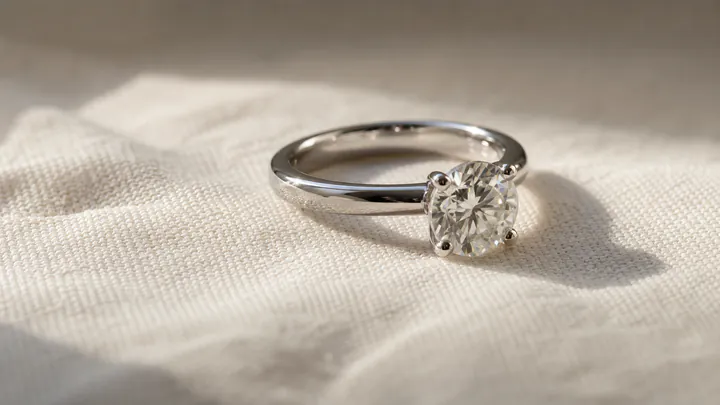
Short answer: buy the centre stone first, at manufacturer, cutting house or dealer level, and let Cape Town do the setting and the fitting.
- The stone is roughly 80 percent of what you pay. So it is the decision, and the metal, the halo and the band style come last rather than first.
- Cheaper. A retail counter buys its stones at exactly that level and then roughly doubles the price, about three times in a branded showroom, while one trade level to the next is commonly 3 to 5 percent. Same stone, one step earlier, and Cape Town has no diamond price of its own.
- Better. The colour and clarity a careful buyer wants are about five times more common at that level: 52 percent of trade-access stock against 9 percent of retail-held stock. That is which shelf you are shopping from, not which city you are in.
- They do the rest too. Setting, bespoke work, resizing, re-plating, re-tipping, insurance valuations, repairs and buy-back, usually on their own bench. A Cape Town counter mostly sends that work out to a bench like theirs.
Go to a Cape Town showroom instead only if the proposal has a date on it, if trying finished rings on together is part of the point rather than an inconvenience, or if you want the brand and the box.
Engagement rings in Cape Town: the centre stone is most of your spend
Most of the Cape Town diamond trade clusters into a short walk: the V and A Waterfront’s jewellery wing and the Gardens and Sea Point ateliers behind it, where showroom rent and tourist foot traffic get folded into the price you are quoted. That premium sits almost entirely in the setting and the service, because on most engagement rings in Cape Town, South Africa the natural centre stone is roughly 80 percent of what you pay and the mount the rest. Yet almost every showroom conversation I have watched in the Cape starts with the metal, the halo, and the band style. That order is backwards, and it is where money quietly leaks.
So lead with the stone. Our June 2026 inventory count, 230 GIA-certified natural diamonds listed with their specifications by six South African sellers, was collected to answer the question Cape Town buyers usually ask backwards. The question is not what the city charges. It is what is actually in the case. Of the stock physically held in South African retail, 9 percent met premium specification, meaning D to G in colour with VS2 or better in clarity. Of the stones a seller could reach through trade access, 52 percent did. None of that is a Cape Town problem or a Johannesburg advantage. It is a question of which shelf you are shopping from. If you only remember one thing about engagement rings in Cape Town, remember that you are buying a four-character specification and not a carat number, and that the specification is what the price is really tracking. Remember too that with most online sellers you are paying for a stone still sitting in someone else’s catalogue. The safer drill is to verify the GIA report number first and then get in front of that exact stone, which a Cape Town buyer can do on a video call or on a one-day trip north.
Cut comes before everything, including budget
Of the four Cs, cut is the one that decides whether the ring actually sparkles across a restaurant table, and it is the one Cape Town retail talks about least because it is the hardest to upsell. A poorly cut 1 carat stone looks smaller and duller than a well-cut 0.90, and it will cost you more for the privilege. Insist on GIA Excellent cut, and for a round brilliant ask to see the stone next to a benchmark. This is where a true cutting house has an edge over a reseller: the people who cut the stone can tell you exactly why it performs, because they ground the facets themselves.
That brings up a distinction most Cape Town buyers never hear. With an on-demand seller, the diamond is requested from a larger external catalogue and shipped in only after the sale, which means you commit and pay before the stone is even in the country. Reach really is where the better goods sit, as the inventory figures above show, and it is worth being fair about that. What reach cannot do is look at the diamond on your behalf. On that route you are buying a photograph and a report number, not a stone anybody has held.
Three Cape Town buying routes, honestly compared
There is no single right answer, but there are three real paths and each has a trade-off.
Cape Town retail showroom. The walk-in CBD or Waterfront jeweller wins on convenience, service, and the romance of trying rings on together. The cost is margin and, often, specification. Margin, because a counter price is a keystone price, roughly double the trade cost, and a branded room can run to three times. Specification, because a case is stocked to hit price points, which is what the 9 percent figure above is really describing. Neither of those is a scandal. It is what the shop costs to keep open. Showrooms are excellent for design feel and finger sizing. Use them for that, and verify the stone specification separately.
Online or on-demand dealer. Wide selection, sharp-looking prices, and you can shop from your couch in Sea Point. The catch is the source-on-demand model above: you are trusting a render and a report number for a stone that may still be overseas. Workable for a confident buyer who verifies the GIA report, riskier if you want to see sparkle before you commit.
A seller working at trade level. The third route is to buy from someone whose business is stones rather than shop windows, and who will put loose diamonds on a tray and quote the stone apart from the setting. The advantage here is structural, not promotional. Margins between one trade level and the next are commonly 3 to 5 percent, and the price roughly doubles once, at the moment a stone crosses to a retail counter, so buying before that crossing costs less for the plainest of reasons: you have not paid for the crossing. That is the trade’s own published convention, and it is arithmetic rather than a finding of ours, which is exactly why we lean on it instead of on our own price data. What you give up is the showroom afternoon, and you take on the work of comparing quotes yourself.
All three of those routes are legitimate, so the comparison has to happen further down, at the level of what each seller will actually do for you. Put identical questions to the Waterfront showroom, the online dealer and the trade-level seller, and give each of them a column. Who is holding this stone today. What is the GIA report number, so I can check it before I travel anywhere. What does the diamond cost with the setting stripped out, on the same VAT basis. What happens if I decide against it. The diamond buying checklist keeps that wording constant from one to the next, which matters more in the Cape than almost anywhere, because you are often weighing a room you can walk into against a seller you will only ever meet on a screen.
What a one-carat Cape Town ring really costs
Write two numbers down before you walk into anything, and write down what is inside each of them.
The first is the loose stone. A one carat G/VS1 works out at roughly R72,000 to R92,000 including VAT on the published trade list: $5,400 per carat on the Rapaport round list of 20 March 2026, less 10 to 30 percent, converted at 16.50 rand to the dollar with 15 percent VAT added. That is a bare stone, no setting and no making in it, and you can redo the arithmetic yourself with this week’s list.
The second is the counter. In our July 2026 sample of 73 rows, 71 of them carrying a price, across 18 sellers, 17 of them South African, a one carat ring in a premium South African showroom ran R105,000 to R428,000. That one is a finished ring with the mount in the price, and it rests on three listings of three different specifications rather than one specification priced three times, so read it as what a premium room charges for “a one carat ring”. We publish it as a band across many sellers rather than as a single stone with a rand figure beside it.
Read the two together carefully, and remember one has a setting in it. The lower end of the showroom range is close enough to the loose stone figure that a showroom is clearly not automatically expensive. The upper end is several times it, so it is not automatically fair either. What separates the two ends is mostly the same thing each time: how many counters the stone crossed, and what the last one had to cover.
We did not measure setting prices as a category, so this page is not going to hand you a mount figure. Ask for it as its own line, with the metal, the weight and the labour specified, on the same VAT basis as the stone. And if a Cape Town showroom quotes a finished one carat ring for less than a loose one carat costs off the trade list, that is not a Cape Town bargain. It is a different diamond, usually lower in colour or clarity, sometimes lighter than the round number on the ticket. Ask for the GIA specification and the comparison evaporates. Our diamond rings for women page walks through the same build in more detail.
A note on lab-grown, because Cape Town showrooms now push it hard. A lab one-carat is a fraction of the price, genuinely beautiful, and a defensible choice if budget is the priority and you have told your partner. Just be clear about the trade-off. Lab prices have fallen very steeply and are still falling, with published estimates of the drop running from around 70 percent to 96 percent depending on the base year and the size measured, and the resale side is thin, with published figures sitting at somewhere between 10 and 40 percent, on estimates that disagree sharply with each other, of purchase price where a buyer can be found at all. A good some jewellers will not take one back on any terms. Buy it for the ring it makes, not for what it will be worth later. A natural GIA stone holds meaning and some value in a way a lab stone currently does not.
My buying route for a Cape Town engagement ring
For the wider national picture behind everything above, read our diamond price index for South Africa and our roundup of the best engagement rings in South Africa.
When you are ready to look at stones rather than stickers, the search matters more than any shortlist I could give you. Do not go looking for a diamond dealer or a wholesaler. Hardly anyone does, roughly 30 searches a month across the whole country, and what comes back is not the kind of seller worth your time. Search what a one carat diamond costs, or the diamond price per carat in South Africa. Sellers who publish a per-carat number have decided in advance to be compared on it, and for a Cape Town buyer that is the practical filter. It tells you who is worth a video call, and which one is worth the flight.