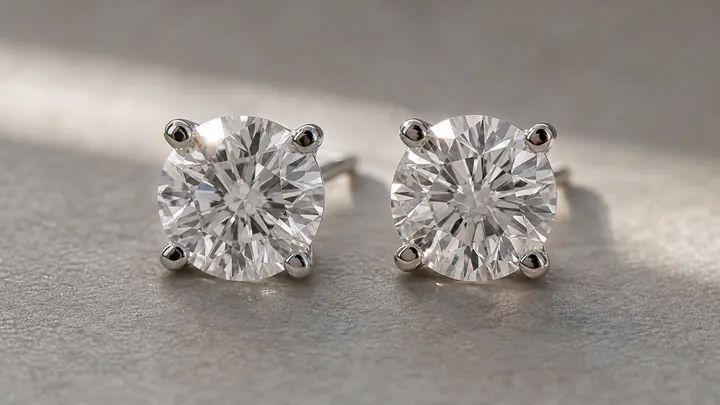
Short answer: buy huggies from a manufacturing jeweller or a workshop that actually makes hoops, and make the quote show the gold, the making and the melee as three separate numbers.
- Cheaper, and on this piece it is the metal and the making that benefit. Keystone is a percentage, so a counter roughly doubles the gold and the bench work along with the stones, about three times in a branded showroom. The diamonds are the smallest line on a huggie, so this is where the money actually is.
- Better. The specification most buyers want is about five times more common at trade level: 52 percent of trade-access stock against 9 percent of retail-held stock. That was certified stones rather than melee, and colour consistency across a row is the first thing to slip at the cheap end.
- They do the rest too. The hinge, the wall thickness, the pavé setting, retightening the fitting in ten years, insurance valuations, repairs and buy-back, usually on their own bench. A retail counter mostly sends that work out to a bench like theirs.
Go to a showroom instead only if there is a birthday on Friday, if you want to try several finished widths against your own lobe, or if you want the brand and the box. On a light everyday pair the margin you would be chasing is a couple of thousand rand, so if a counter has one that fits and clicks shut cleanly, buy it and wear it.
On a pavé huggie the diamonds are usually the cheapest part of the piece. I have priced enough of these to say it plainly: on a 0.30 carat total weight pair of natural diamond huggies, the gold and the labour of setting twenty-odd tiny stones evenly will often cost more than the stones themselves. That single fact changes how you should read a quote for diamond huggie earrings in South Africa, because the pitch you usually hear leans on carat and diamond, while the real money sits in the metal and the bench work.
What a huggie actually is, and why it prices differently
A huggie is a small hinged hoop that sits tight against the earlobe. The diamonds are nearly always melee, individual stones well under 0.10 carat, set in a row of claws, a channel, or pavé along the front face of the hoop. That construction is the whole story when it comes to price and quality.
Three things drive the ticket, in this order:
- The metal and its weight. Solid 9ct or 18ct gold, and how many grams of it the hoop uses. A chunky 18ct huggie can carry more cost in gold than in diamond.
- The setting labour. Setting many tiny stones level and evenly spaced is fiddly handwork. A clean pavé line is a sign of a good bench, and you pay for it.
- The diamonds. Total carat weight, natural versus lab-grown, and the colour and clarity range of the parcel. On a small huggie this is often the smallest line.
So when a quote leads with carat weight and a brand name but goes quiet on metal grams, hinge type and whether the stones are natural, it is steering you away from where your money actually goes.
The hinge is the part that fails first
Studs fail at the butterfly back. Huggies fail at the hinge. A huggie is worn and unworn dozens of times a month, and a cheap hinge develops play, then a gap, then a snag that catches hair and clothing. Before you buy, work the hinge several times. It should close with a clean, definite click and sit flush with no visible gap at the join. A flimsy snap or a hoop that springs back open is a mechanical fault you should reject, not negotiate.
For everyday wear this matters more than half a colour grade. A huggie you trust to put in and forget is the point of the piece. If you are weighing huggies against a more classic everyday option, my stud earrings guide covers the post-and-back trade-offs, and the broader diamond earrings guide sets out where each style earns its place.
Matching the melee
On a single huggie, and across the pair, the small stones need to look like one set. Colour is the giveaway: a row that mixes a near-colourless stone with a faintly tinted one reads as patchy in daylight even if no single stone is bad. Under a loupe or your phone’s macro mode, the line should look even, with no stone sitting proud of its neighbours and no milky or dark outlier breaking the run. This is parcel discipline, and it is exactly the kind of thing a busy retail counter does not check for you.
What the numbers say
Carat weight tells you little about a huggie on its own. The figures I have were collected on larger certified stones, and two of them still bear on a pair of hoops. First, what sits in a South African retail case runs markedly lower in specification than what the trade can reach: of 230 GIA-certified natural diamonds listed by six sellers here in June 2026, about 9 percent of the retail-held stock reached D to G colour with VS2 clarity or better, against 52 percent of the stock held by sellers working with trade access. That counted single certified stones and not melee, and I have no equivalent count for small goods, because melee is sold by the parcel and never graded stone by stone. The parcels come out of the same inventories all the same, so expect the colour consistency that makes or breaks a huggie to be the first thing to slip at the cheap end. Second, specification moves price far more than size does, which is why matched colour across a row is worth more to the finished pair than another tenth of a carat on the total weight. The method behind those figures is in the South African diamond price index.
For a like-for-like natural diamond huggie pair, I would budget roughly:
- R6,000 to R10,000 for a light pair, around 0.20 to 0.30 carat total weight, in 9ct gold with modest clarity. Treat this as an estimate range derived from typical metal and melee costs, not a fixed quote.
- R12,000 to R20,000 for a heavier 18ct pair, 0.40 to 0.50 carat total weight, with tighter colour matching and a better hinge.
Those are guide bands to sense-check a quote, not study findings. If a pair is priced well below the low end, ask what gave: it is usually thinner gold, lab-grown stones sold quietly, or a loose hinge.
How the seller behind the counter changes the deal
Most diamonds sold online in South Africa are ordered in on demand from a much larger catalogue, which is normal and works well enough for a single certified centre stone. On a hand-set huggie it tells you nothing, because a pair of huggies is a small row of stones that has to read evenly around a curve, and a catalogue cannot match that. Someone has to hold the stones side by side, and you want to know who.
Half the diamond buying checklist assumes a certified centre stone, and a huggie has neither a certificate to check nor a single diamond to hold anybody to, so here it wants translating rather than following. Instead of asking whether the stone is held, ask whether the melee parcel was matched by someone who saw it, and whether both hoops were set from the same parcel. Instead of verifying a report, get the total carat weight and the colour range in writing with the word natural on the invoice. Then pull the price into its three real parts: gold by the gram, the making as its own charge, the stones as theirs, VAT inside all of it. And ask the one question no checklist carries, because only a hinged piece needs it: who services the hinge, and for how long. Two quotes broken down that way can be compared honestly. Two finished stickers cannot be compared at all, whoever is standing behind them.
Huggies in the wider earring picture
If you are still deciding on style, weigh huggies against the alternatives honestly. Studs are the daily classic and live or die on pair-matching of two larger stones. Drop earrings are occasion pieces where weight and movement matter. Huggies sit between the two: everyday, close-fit, low-snag, and built around a row of small stones rather than one or two showpieces. For most buyers who want diamonds they actually wear daily, that makes huggies the easiest pair to live with, provided the hinge is honest and the melee is matched.
Where trade level helps on a huggie, and where it honestly does not
I want to be straight about this one, because the right answer on a huggie is not the right answer on a solitaire.
On most diamond pages the case for buying at trade level is about the stone. A retail jeweller’s supplier is a diamond dealer. The jeweller buys at trade level and adds a margin, trade convention is keystone, meaning roughly double the cost at the counter with branded showrooms at around three times, and the margins between one trade level and the next run only about 3 to 5 percent a hop. On a certified centre stone that final step is worth tens of thousands of rand and it settles the whole decision. On a pair of huggies it is not, because as I said at the top, the melee is the smallest line on the ticket. Stripping the margin off the diamonds in a 0.30 carat pair does not change your life.
What does change on a huggie is the hinge, the gold and the setting, and those are manufacturing questions rather than diamond ones. So the level worth finding here is a manufacturing jeweller or a workshop that actually makes hoops rather than buying them finished: someone who quotes the gold by the gram and the making as its own line, will tell you the wall thickness and the hinge type without being pushed, and can service and retighten the fitting in ten years because they built it. That pricing structure is the real prize. A retail sticker is one number with metal, labour, melee and margin folded together, and you cannot tell which of the four you are arguing with.
Keystone is a percentage, so it treats the gold and the bench work exactly as it treats the stones. On a huggie, where metal and labour are most of the cost, that is precisely where the doubling lands.
Which gives a mixed conclusion, and I think an honest one. If you want a light everyday pair and a counter has one that fits your ear and clicks shut properly, buy it and wear it. The margin you would be chasing is a couple of thousand rand and the shop gives you something back for it. If you are commissioning a heavier 18ct pair, or you want a particular width, a particular melee colour, or a hinge you can have serviced for twenty years, the workshop route is the only one that reliably gets you those things at all, and the price is a secondary benefit rather than the reason.
Either way the same three questions do the work. What does the pair weigh in gold, and what is the making charged at separately. Is the melee natural, and what is the total carat weight and colour range in writing. And who do I bring these back to when the hinge develops play, because eventually it will.
Sources and references
- Natural Diamond South Africa inventory study, 230 GIA-certified natural diamonds listed by six South African sellers, June 2026.
- GIA diamond education
- GIA Report Check