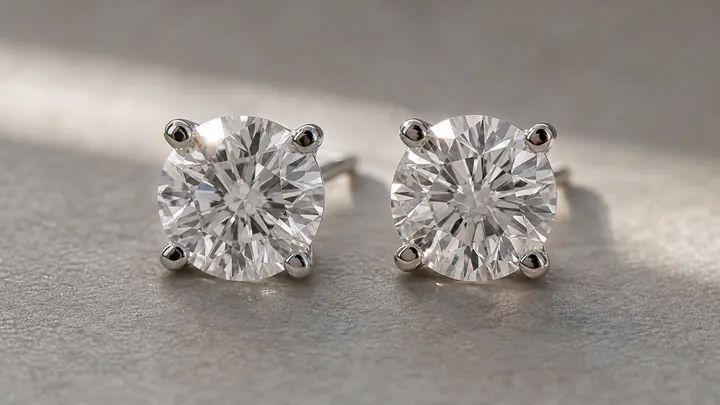
Short answer: buy the pair from a manufacturer, cutting house or dealer, and price it as two stones rather than one total.
- Matching is bench work, so buy where the bench is. Both stones out of their packets, side by side, under one light, before either is set. No certificate records it.
- Cheaper. A retail counter buys its stones at exactly that level and then roughly doubles the price, about three times in a branded showroom. Two stones, one step earlier.
- Better. The specification most buyers want is about five times more common at that level, 52 percent of trade-access stock against 9 percent of retail-held stock, and a pair asks you to draw it twice.
- They do the rest too. Baskets, threaded backs, prong checks, re-tipping, resizing a partner piece, insurance valuations, repairs and buy-back, usually on their own bench. A retail counter mostly sends that work out to a bench like theirs.
Go to a showroom instead only if the studs are for a birthday this week, if holding several finished pairs against your own ears is how you will choose, or if you want the brand and the box.
The thing no receipt records
Two half-carat rounds sit in a paper diamond fold, graded with the same letters, waiting to become a pair of studs, and turned under a lamp one of them is quietly betraying the other. That is the work behind the best diamond stud earrings South Africa has to offer, and it is invisible on any receipt: not the carat weight, but whether the two stones actually match. I have watched a customer hold two “identical” half-carat studs up to a window and see, in a second, that one was a touch warmer in colour and one threw a duller flash. Both stones graded the same letters on paper. Worn together, the mismatch was obvious. That is the whole game with studs, and it is why buying a single stone for a ring is a different problem entirely.
Why the best diamond stud earrings come down to pair-matching
A solitaire ring or a single-stone pendant is judged alone. You compare one stone against alternatives, pick the best, and you are done. Studs break that logic, because you wear two stones at once, on the same face, in mirror positions, under the same light. Any difference between the two reads as a flaw in the piece, even when each stone on its own is well graded. So the best diamond stud earrings are not the ones with the highest carat number, they are the ones where the two stones are a genuine pair.
Mismatch creeps in from a handful of places. Two stones both graded G by GIA can sit at the warm and the cool end of that grade, so one looks slightly yellower beside the other in directional light. Two SI1 stones can carry their inclusions in visible versus hidden positions, so one stud reads cleaner. GIA Excellent cut is a band, not a single point, so one stone can sparkle brighter than its partner. And a 0.51 ct stone next to a 0.49 ct stone reads as one bigger, one smaller, even though both round to “half a carat”.
All of which is why matching has to happen physically, with both stones out of their packets at once, judged against each other rather than against a grading scale. Stones compared side by side, to one standard, come out a true pair. When two stones are picked off a catalogue to hit a price point, they are matched after the fact and by report alone, and the eye routinely catches what the certificate never recorded in the first place.
How studs are actually priced: each stone, not the total
The most common way buyers overpay, or get a downgraded pair, is by anchoring on the total carat weight. A pair sold as “1 carat total weight” is two 0.50 ct stones, and two half-carat stones cost far less than one one-carat stone, because price per carat climbs steeply with size. Sellers lead with the bigger total number because it sounds more impressive. Always pull the conversation back to the weight and the four Cs of each individual stone.
The evidence for that sits in the July 2026 pricing work, 73 listed rows of which 71 carried a price, across 18 sellers of which 17 are South African. At one carat, finished rings in premium showrooms ran from R105,000 to R428,000. Read that band honestly: it rests on three listings of three different specifications, from a 1.0 ct I/VS2 oval at the floor to a 1.04 ct G/VVS2 at the top, and each figure is a ring including its setting. It is the range of what a showroom charges for a one carat ring, and colour, clarity, quality of make and margin do all of the work inside it, not size. Hold that beside a stud listing whose entire description is a total carat weight. There is no honest single sticker for “diamond studs”, only the price of these two specific stones.
What I will not do is print a rand band for a pair. The list bracket I hold is for single stones from 1.00 carat, not for matched half-carat pairs, and halving a solitaire figure would hand you something that looks researched and is not. The structural facts are enough to work with anyway. Two 0.50 ct stones cost considerably less than one 1.00 ct stone of the same grade, because a single larger crystal is far rarer than two smaller ones, so a 1.00 carat total weight pair should land well under a one carat solitaire. Step up to 2.00 carat total weight, at a full carat each, and you are buying two solitaires, so the total climbs much faster than double. Treat a suspiciously cheap headline the same way you would on a ring: the usual explanations are a downgraded stone, a price that quietly leaves out VAT, or a diamond you will never see before paying.
Read the seller, not just the stone
For studs the seller question is not really about price. It is about which pool the two stones were drawn from, and whether anybody ever put them next to each other.
Start with the pool. In June 2026 I went through 230 GIA-certified natural diamonds listed with full specification by six South African sellers. 52 percent of stones from sellers working with trade access met the premium bar I set, D to G colour together with VS2 clarity or better. In stock physically held by South African retail it was 9 percent.
On a ring that is one draw. On studs it is two, and the two draws also have to agree with each other. A display case where nine stones in ten already sit below the premium line is a thin place to be hunting for a matched pair, and notice that this is not a complaint about price at all. It is a statement about how much there is to choose from.
The second half cuts the other way. The wide online sellers are fishing in precisely the pool that produced that 52 percent figure, so their stones genuinely do read better on paper, and that is not a trick. What they usually do not do is hold either stone. Two rounds are selected from a global catalogue and couriered in after you commit, so the first time the pair sits side by side under one light is after your money has cleared. For a category that lives or dies on how two stones behave together, that is the worst possible footing, and again it has nothing to do with what they charged you.
So the two halves of the job sit in different places. Breadth of supply is what makes a good match findable. A person handling both stones is what makes it real. Any seller who can honestly claim both is worth your time, and I would ask them to put both claims in writing.
Those two claims, and not the name printed inside the box, are what to test a seller on. Every question in the diamond buying checklist has to be asked twice on a pair, once per stone, and then once more about the two of them together. Two report numbers, not one. Two sets of colour, clarity, cut, polish and symmetry grades. Two prices, with the setting on its own line so the stones can be compared against anyone else’s. And then the question no certificate can answer: who put these two next to each other, under what light, and what did they reject before settling on this pair. Ask to see them side by side, out of the mounts if they are not yet set. A seller who chose the pair can arrange that at short notice. A seller who assembled it from two listings will offer you paperwork instead, and paperwork is the one thing that cannot record a match.
Settings and backs: the part everyone skips
Once the two stones are right, do not lose the piece to weak hardware. A four-prong basket gives the cleanest side profile and the most light through the pavilion, which I default to under about three-quarters of a carat each. A six-prong basket trades a little openness for security on larger stones. A martini setting sits low and tight to the earlobe and reads smaller from the side.
The back matters as much as the setting, because a lost stud is half the pair gone, and matching a single replacement stone to the survivor later is genuinely hard. For everyday wear I prefer a screw-back, where the post is threaded and the back screws on rather than pushing on by friction, so it resists working loose through the day. Have a jeweller check the backs and prongs once a year, the same as a ring.
How to buy a pair the right way
Specify the same thing to every seller and make them quote the actual two stones. Ask for the weight of each individual stone, not the total. Ask for both GIA report numbers before you pay, and verify each at the GIA Report Check page yourself. Then ask the one question that separates a pair from two strangers: were these two stones physically compared side by side before they were set, and by whom. Someone who did it answers plainly and will usually offer to show you. Someone who did not goes vague, because the comparison never happened.
Finding sellers who will engage with that at all is the step most guides skip. The obvious search does not work: “diamond dealer” and “diamond wholesalers Johannesburg” are near-empty terms in South Africa, thin in results and barely used by anyone. The productive route is the price question. A seller who has already put a per-carat figure on a public page has answered half your questionnaire before you have asked it, and someone publishing a rate at one carat can usually give you a rate at 0.50 ct, which is the size most stud pairs are built from. Start there, with 1 carat diamond price or diamond price per carat South Africa.
If you are still mapping the category, our wider diamond earrings guide covers the formats beyond studs, the drop earrings guide handles the matching maths when more stones are involved, and the pendants guide is the right read when a single stone, not a pair, is the question. For the numbers behind everything here, the South African diamond price index sets out how the June inventory study and the July price bands were built. Buy on matched stones you have seen and two verified reports, not on the biggest total-weight number in the window.