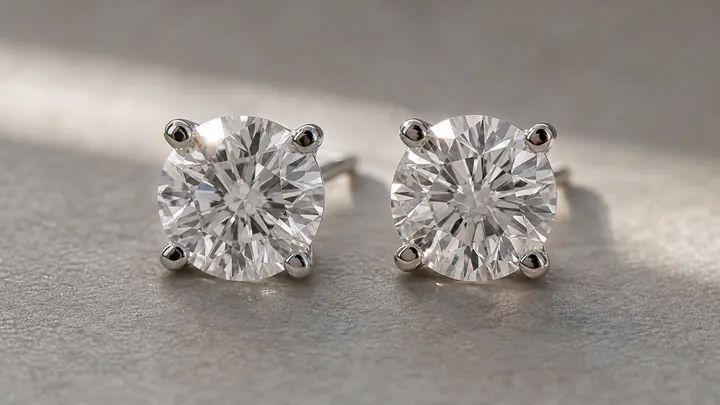
Short answer: two 0.50 carat stones cost materially less than one 1.00 carat, and for a serious pair you buy at manufacturer, cutting house or dealer level.
- Cheaper. A counter buys its stones at exactly that level and then roughly doubles the price, about three times in a branded showroom. Same two stones, one step earlier, and Cape Town has no diamond price of its own.
- Better matched. A counter can only pair the stones it already owns, while matching a second stone to a first is ordinary work one step up the chain, where the specification most buyers want is about five times more common: 52 percent of trade-access stock against 9 percent of retail-held stock.
- They do the rest too. Screw-back posts, martini and claw heads, prong checks, re-tipping, insurance valuations, repairs and buy-back, usually on their own bench. A city-centre counter mostly sends that work out to a bench like theirs.
Go to a Cape Town counter instead only if there is a birthday this week, if you want finished pairs on your own ears before deciding, or if you want the brand and the box. Under about half a carat total, that is what I would do myself.
A matched pair of half-carats costs less than one whole carat, but matching is where the money hides
Buying diamond earrings Cape Town South Africa is the one purchase where the plain carat maths works in your favour and still trips people up. A 1.00 carat total stud pair, two stones near 0.50 carat each, costs materially less than a single 1.00 carat solitaire of the same grade, because one big crystal is far rarer than two smaller ones and the size premium on a full carat is steep. What the pair asks of you instead is matching. Two 0.50 carat stones that genuinely agree, same colour, same clarity, same cut, same face-up brightness, are harder to assemble than one good stone, and a careful cutter prices that matching work in. So the saving over a solitaire is real, but it is smaller than the raw carat maths suggests, and a “1 carat” pair at a suspiciously soft price is usually telling you the two stones do not truly match. The first question is not the price. It is what the two stones are.
That is the lens for the rest of this page. Earrings are not a single-stone purchase doubled, and the pair is not more expensive than a solitaire of the same total weight, it is less. What actually decides studs over a ring is not price at all, it is style and security: how a pair frames the face, and how safely two stones stay put in daily wear. Once you accept that, earrings become a matching problem, and the matching is where the value and the traps both live.
Why a pair is a different purchase from a ring
With a solitaire you judge one diamond. With studs your eye judges two at once, side by side, and the brain is brutal at spotting a mismatch. A faint colour difference you would never notice in isolation becomes obvious when one ear reads a shade warmer than the other. The same goes for size and for the little flash differences a clarity gap creates.
So the spec conversation for earrings has an extra axis. You are not just choosing a colour and clarity grade, you are asking how tightly the two stones were matched against each other. A serious supplier will tell you both stones sit in the same colour band and were brightness-checked as a pair before setting. A weak one sells you “G-H, SI” and lets you discover the mismatch under the bathroom light at home.
Which is where the diamond buying checklist needs adapting, because it is written in the singular and a pair is not one purchase. Ask its questions twice over, then add a sixth. Are both stones here today, or is one held and the other still to be found. Are there two report numbers rather than one, and can you check both yourself. Do the diamonds and the setting come back as separate figures with VAT already inside them. What are the written return terms if the two stones do not agree in daylight, which is the only test that counts and the one a showroom ceiling will not let you run. Then the sixth question, the one no checklist carries because it applies to nothing else: what tolerance were these two matched to, and who did the matching. That is what separates a matched set from two diamonds that happen to weigh the same.
What earrings actually cost: anchoring on real numbers
The honest way to price a pair is to price the two stones first and add the setting afterwards. Two pieces of my own research help with that, and it is worth saying up front that neither of them is a stud price.
Across the 73 listings I recorded in July 2026, 71 of them carrying a price, from 18 sellers of which 17 are South African, a finished one carat piece at a premium showroom here ran R105,000 to R428,000. That band includes the setting and rests on three listings of three different specifications, so read it as the spread of what a showroom charges rather than one stone priced three ways.
For the bare stone the published list is the better anchor, because you can redo the sum yourself. Rapaport’s round list of 20 March 2026 puts G/VS1 at 1.00 to 1.49 carats at $5,400 per carat, which works out at roughly R72,000 to R92,000 for a loose one carat including VAT, converting at R16.50 to the dollar and depending on the discount off list, with about R82,000 at 20 percent off. Most of the distance between a bare stone and a counter price is structural rather than about the diamond. Retail convention is keystone, roughly double the trade cost at the counter, a branded showroom runs to about three times, and the steps between one trade level and the next are commonly 3 to 5 percent.
Now translate that to a pair, carefully, because a stud pair is not a one-carat stone. A 1.00 carat total weight pair is two stones near 0.50 carat each, and a half-carat stone costs considerably less per carat than a one-carat, since the large single crystal is the rare thing. A matched 1.00 carat total pair at the same grade therefore lands well below a single 1.00 carat solitaire, even after the premium for matching. Use those one-carat bands as a ceiling and a sanity check, never as a stud quote. Where a pair actually catches you is the matching and the setting, so read a pair priced like two throwaway stones as a prompt to check colour, clarity, matching and VAT rather than as a bargain.
The specification question has its own number behind it. Listing 230 GIA-certified natural diamonds offered by six South African sellers in June 2026, only 9 percent of the 137 stones held in South African retail stock were D to G in colour and VS2 or better in clarity, against 52 percent of the 93 stones reachable through trade access. For a pair that single line is the whole difficulty: you need two diamonds that agree with each other, drawn from a pool in which a good stone is the exception. The full breakdown is in our South African diamond price index.
Total carat weight, and the trick to watch
When a Cape Town tag says “1 carat diamond earrings”, read it carefully. Almost always that is total carat weight, two roughly 0.50 carat stones, not two 1.00 carat stones. That is normal and fine, as long as you know which one you are buying. The trap is a tag that lets you assume the bigger reading. Always confirm: is that per stone, or total weight across the pair?
A quick size map for studs, since most earring buyers know the format already:
| Total carat weight | What you are really buying | Grading note |
|---|---|---|
| 0.25 ct total | Two ~0.12 ct daily studs | In-house grade is normal |
| 0.50 ct total | Two ~0.25 ct studs, the gift sweet spot | Ask the colour and clarity band |
| 1.00 ct total | Two ~0.50 ct stones | Ask for a GIA number per stone |
| 1.50 ct total and up | A serious diamond purchase in two parts | Two GIA reports, matched as a pair |
Settings: the part gym bags and daily wear punish
A stud’s worst enemy is a lost stone, and that is a setting question, not a diamond question. Two things to ask before you pay:
First, the back. Friction butterfly backs are fine for small light studs but they loosen with wear. For anything from about 0.50 carat per stone upward, ask for screw-back posts. They thread on and stay on, and on a pair you actually wear daily that is the difference between owning the earrings in five years and not.
Second, the head. A four-prong or three-prong martini setting holds a round brilliant securely while letting light in. Make sure the prongs sit tight against the girdle on both stones, and have them checked once a year, the same way you would a ring. A snagged prong on a jersey or a gym bag is the most common way a good stone goes missing.
Lab-grown versus natural for a pair
Lab-grown studs are tempting, and on a pair the temptation doubles, because the saving falls on two stones instead of one. Be clear about the trade you are making, though. Lab-grown prices have fallen very steeply and are still falling, with published estimates of the decline running from roughly 70 percent to as much as 96 percent depending on the base year chosen and the size measured. The resale side is thinner again: a shallow secondhand market, and many jewellers who will not buy lab-grown back at all.
That lands on earrings in one particular way. People upgrade studs. The usual path is a modest pair now and a larger matched pair at a milestone, with the first pair traded in or handed on, and that path only works if somebody wants the first pair. So for everyday studs, lab-grown is a sensible buy and I would not argue anyone out of it. For a pair meant to be the beginning of something, I would take smaller natural stones over larger grown ones. Whatever you choose, get the origin written on the quote. Our natural versus lab-grown guide goes deeper.
How I would actually shop, from Cape Town
Decide the format and the total carat weight first. Then send one clear spec to two or three suppliers and compare like for like: “a matched natural diamond stud pair, 18ct white gold, 1.00 carat total weight, G to H colour, VS2 to SI1 clarity, GIA report number per stone, price quoted with VAT, stone price and setting price shown separately.” Send that to a Cape Town retailer for service and feel, and get a second quote from a seller working at trade level so you have a real matched-pair benchmark. Then read the two stones, not the two prices.
Finding that second quote is a search problem with a counterintuitive answer. Diamond dealer and diamond wholesalers Johannesburg return almost nothing, and a Cape Town buyer who tries them will come away thinking the trade is closed to the public. Search the price question instead, 1 carat diamond price or diamond price per carat South Africa, and the sellers who publish real per-carat numbers appear. Ask each of them for a per-stone number at your matched specification. Distance matters less than it sounds, provided you insist on the thing you would insist on in a shop: the pair hung side by side and looked at, by you or by somebody acting for you, before any money moves.
For studs specifically, our best diamond stud earrings guide covers face-up matching in more detail, the wider diamond earrings overview covers drops and hoops, and where to buy diamonds in South Africa covers the cutting-house-versus-retail question across the whole market. Cape Town is a fine place to buy earrings. Just buy the pair, not the postcode.
Sources and references
This guide uses my own 2026 South African research, being a June 2026 listing of 230 GIA-certified natural stones offered by six sellers and a July 2026 pricing of 73 listings across 18 sellers, 17 of them South African, plus the published Rapaport list and published grading references, all checked at the date above.
- naturaldiamond.co.za June 2026 South African diamond inventory listing
- naturaldiamond.co.za July 2026 South African diamond price research, 73 rows and 71 prices across 18 sellers, published as bands only
- Rapaport round brilliant price list, 20 March 2026, G/VS1 at 1.00 to 1.49 carats, $5,400 per carat
- GIA Report Check
- GIA diamond education