Bottom line up front
Short answer: price a bracelet on total carat weight rather than one hero stone, and buy a natural line from a manufacturer, cutting house or dealer.
- Cheaper. A retail counter buys the same matched parcel at that level and then roughly doubles the price, about three times at a branded name. You pay for identical work one step later.
- Better. The matching is the product, and specification is about five times more common up the chain: 52 percent of trade-access stock reaches D to G colour with VS2 clarity or better, against 9 percent of retail-held stock. A line of fifty stones is fifty chances to drop a grade.
- They build and service it too. Matching, stringing, rebuilding a tired clasp, re-tipping, insurance valuations and buy-back are bench work, often on the bench that made the piece. Most dealers, manufacturers and cutting houses run one or work with one, and a counter mostly sends those jobs to a bench like theirs.
- Check the clasp before anything else. It is the part almost nobody inspects and the part most likely to cost you the entire bracelet.
Use a showroom instead if you need the bracelet by the weekend, want to try half a dozen widths and clasps on your own wrist this afternoon, or want the name on the box as part of the gift.
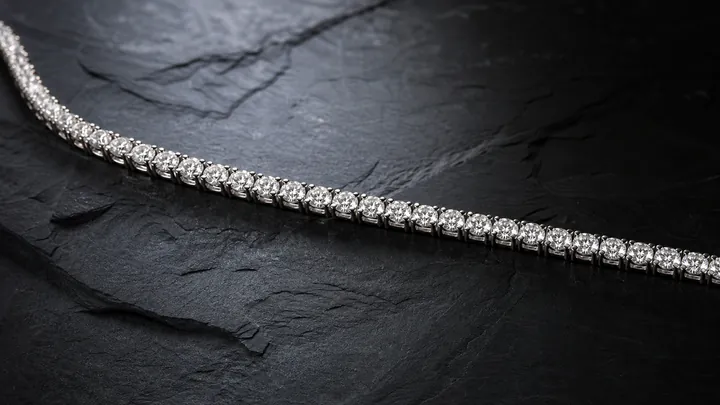
The first job either way is to decide which bracelet you actually mean: a continuous tennis line, a diamond bangle, a station bracelet with stones spaced along a chain, or an inherited gold piece you want valued or remade. Each is bought differently. The trap is reading a bracelet like a ring. With a solitaire you are judging one diamond. With a bracelet of fifty small stones you are judging a whole parcel and the engineering that holds it together. Get the parcel and the clasp right and the metal colour is almost a footnote.
A bracelet is bought by total carat, not one stone
A line bracelet holding forty to sixty small diamonds is, in effect, forty to sixty small purchases bundled into one price. So the number that drives the cost is the total carat weight, often written as TCW or ct.tw., and the figure that drives the quality is the average colour and clarity across the whole line, not the single best stone the salesperson points at.
Small calibrated diamonds, the melee used in bracelets, trade at a lower price per carat than a single one carat solitaire of the same colour and clarity, so a three carat total weight bracelet does not cost three times a one carat ring. What is real is the quality spread, and on a bracelet it is where cheap gets cheap. Our June 2026 inventory count of 230 GIA-certified natural diamonds listed by six South African sellers found that 9 percent of the stock actually held in South African retail met premium specification, meaning D to G in colour with VS2 clarity or better, against 52 percent of what those sellers could reach through trade access. That count covered individually listed stones rather than melee parcels, so read it as a description of how the market stocks itself and not as a bracelet price. The habit still compounds here, and worse than anywhere else: a line of fifty stones is fifty chances to drop a grade, and nobody is going to volunteer which ones were dropped. A cheap headline on a natural gold and diamond bracelet almost always means the colour and clarity of the parcel has been quietly lowered.
Ask for four numbers in writing before anything else: total carat weight, the colour and clarity range across all the stones, the gold karat, and the gold mass in grams. If a seller can only give you a glossy photo and a single price, you cannot value the piece, and neither can anyone you later try to sell it to.
Stone-to-stone matching is the part you pay for
On a single diamond, you judge that diamond. On a bracelet you judge consistency. A good natural line bracelet has stones matched so closely for colour, clarity and cut that your eye reads one continuous river of light. A poorly matched one has a stone that is visibly greyer or murkier than its neighbours, and once you have seen it you cannot unsee it.
This is genuinely hard to do, which is why matched natural bracelets cost what they do. The maker has to select dozens of stones that sit within a tight colour band, often within one or two GIA colour grades of each other, and within a similar clarity, then calibrate them to the same size so they sit flush. It is the same discipline that goes into pair-matching two diamond studs, scaled up to forty stones. When you compare a tennis bracelet at two very different prices, matching is usually most of the difference even if the total carat weights are identical.
Lab-grown changes this calculation, and it is worth being precise about how. Grown melee costs a fraction of natural melee, and that fraction keeps shrinking. The wholesale index the trade watches for grown stones sits 96 percent below where it started when tracking began in July 2018, and although the rate of decline eased through 2026, the direction has not changed. Second hand it is thinner still: published estimates of what a lab-grown stone recovers on resale are wide and inconsistent, mostly falling somewhere between a fifth and two fifths of the purchase price, and some jewellers will not buy one back at all because they have nowhere to send it. That is why so many cheap “diamond” bracelets are quietly lab. None of that is an argument against wearing one. It is an argument for buying it as the fashion piece it is rather than as something you expect to be worth money in ten years, and for being told plainly which one is going on your wrist.
The clasp is where bracelets actually fail
A ring sits protected on your finger. A bracelet swings off the most mobile joint on your body, catches on car doors, sleeves and gym bags, and is the one piece of fine jewellery that can come off without you noticing until it is gone. The clasp is not a detail. It is the whole risk.
What you want on a line of stones is a box clasp with a figure eight safety catch, or a double tongue mechanism, so that two independent things have to fail before the bracelet drops. A single thin lobster clasp on a heavy diamond line is underbuilt. Ask to open and close it yourself several times: it should click firmly and need a deliberate action to release. Check too that the underlying gold is thick enough to take years of flexing without a solder joint cracking. Most bracelet losses I hear about are not theft, they are a tired clasp on a piece nobody ever pressure tested.
Gold karat and weight: the quiet half of the price
The metal is the half of a gold diamond bracelet that people forget to ask about. In South Africa you will mostly see 9ct and 18ct gold, occasionally 14ct, and platinum on the higher end. 9ct is harder wearing and cheaper but holds less gold; 18ct is richer in colour and heavier in actual gold content, so it costs more and carries more intrinsic value. White gold also needs rhodium plating that wears and wants refreshing every few years, where yellow and rose do not. None of this is hidden, but it only reaches your invoice if you ask, so insist the gold karat and the gold mass in grams are stated separately from the diamonds and the labour.
| Bracelet type | What decides the price and the risk |
|---|---|
| Tennis line | Total carat weight, colour and clarity matching across all stones, clasp and safety catch |
| Diamond bangle | Gold thickness, hinge and safety catch, stone security in the setting |
| Station bracelet | Chain strength, diamond spacing, single stone spec at each station |
| Inherited or dress piece | Gold value, diamond value, clasp condition, remake or reset route |
Buy-back, repair and reset, not scrap
An old gold diamond bracelet should never be weighed in as scrap on the first visit. Ask for four figures, separately and in writing: the gold value at the day’s price per gram, the diamond value based on total carat weight and the colour and clarity range, the condition of the clasp and the chain, and what a remake or a buy-back would pay. A worn line with sound natural stones is often worth more reset than melted, and there is no way to know which until those four numbers are on the same page in front of you.
All four answers come most readily from the level that assembles lines in the first place. A manufacturer, cutting house or dealer is buying at the level it sells at rather than taking your bracelet back into a retail margin, which frequently shows up in the buy-back terms, and if you choose the remake instead, the reset happens on the same bench that just assessed it.
Buying rather than selling calls for the same paperwork, aimed the other way. A bracelet is the piece where a shop name tells you least, because forty or more stones bought as a parcel can be assembled by anybody, and everything that separates a good line from a mediocre one hides inside grades nobody volunteers. So judge sellers on what they will put on paper: total carat weight, the colour and clarity range from the best stone in the line to the worst, the gold karat, the gold mass in grams, and whether anyone in the building actually matched the parcel or it arrived pre-strung. The diamond buying checklist is the longer version of those questions. Put it to two or three sellers, lay the written answers next to each other, and only then look at price, because a line that comes in a third cheaper has almost always been dropped a grade or two somewhere along its length.
For deeper context on what natural diamonds actually trade for, the South African diamond price index sets out our current inventory and pricing findings, including what those figures can and cannot be used for, and if you have settled on a continuous line, the best diamond tennis bracelets in South Africa guide goes further on matching and construction.
Sources and references
- Natural Diamond South Africa inventory study, 230 GIA-certified natural diamonds across six South African sellers, collected 26 June 2026, and pricing sample, 73 rows of which 71 carried a price, across 18 sellers, 17 of them South African and one an international online retailer, July 2026, published as bands.
- Rapaport round brilliant price list, 20 March 2026, G/VS1, 1.00 to 1.49 carat bracket, used with a stated discount assumption at R16.50 to the dollar and 15 percent VAT.
- GIA Report Check
- GIA diamond education