Bottom line up front
Short answer: settle whether you are buying one stone or many, then buy at manufacturer, cutting house or dealer level.
- One stone or many decides how it is priced. A solitaire pendant is priced on a single centre stone. A tennis or riviera necklace is priced on total carat weight across dozens of small diamonds that all have to agree with each other. Treat them as the same purchase and you will misread both.
- One step up costs less, on the trade’s own convention. A retailer buys at that same level and then applies keystone, roughly doubling the figure, about three times at a branded name, while the steps inside the trade run 3 to 5 percent a hop.
- Better goods, and the bench that keeps them. The colour and clarity a matched line needs is about five times more common up the chain, 52 percent of trade-access stock against 9 percent of retail-held. That is also where the line gets matched and set, and where the restringing, clasp work, re-tipping and insurance valuations go afterwards. Most manufacturers and dealers run a bench or work with one, and a counter mostly sends those jobs out to a bench like it.
Take the showroom if the necklace has a date on it, if holding twenty finished lengths and clasps against a collarbone and taking one home the same afternoon is how you want to choose, or if the name on the box is part of the gift.
That first question is also how you read every quote you are sent for diamond necklaces South Africa.
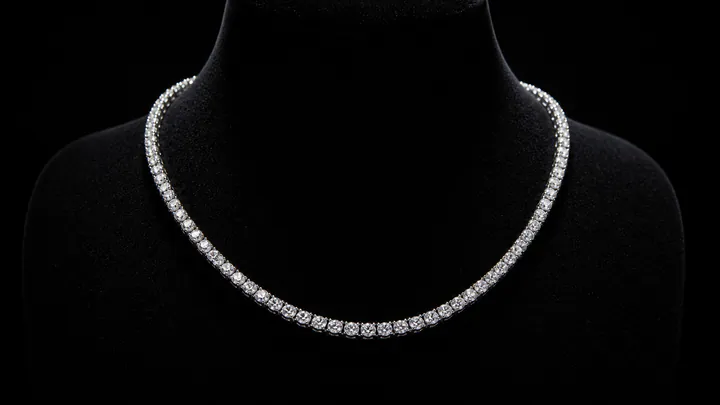
On a tennis necklace the work you are actually paying for is matching. A 5ct line can hold anywhere from 40 to 80 small diamonds, and they have to read as one unbroken river of light around the throat. If one stone is a shade warmer or a touch cloudier, your eye finds it instantly, and the whole piece drops a grade in feel. That sorting is slow, skilled, and wasteful, because stones that fail the match get pulled and set aside. It is why a tennis necklace costs more per carat than a single pendant of identical total weight.
What you actually pay in 2026
These ranges are built up from what a single certified carat costs, not from a shop window, and the anchor is arithmetic you can redo. The Rapaport round list of 20 March 2026 puts a G/VS1 in the 1.00 to 1.49ct bracket at 5,400 US dollars per carat. Take 10 to 30 percent off that list, convert at 16.50 rand to the dollar and add 15 percent VAT, and a loose one carat lands at roughly R72,000 to R92,000 including VAT, with about R82,000 in the middle of that at 20 percent off list. Every one of those inputs moves, so redo it rather than trust it.
A premium South African showroom sits well above that, at between R105,000 and R428,000 for a one carat ring, though that is a finished ring with a setting in the price and it rests on only three listings of three different specifications, so read it as what showrooms charge for “a one carat piece” rather than as one stone measured twice. It came out of a July 2026 study of 73 rows, 71 of them priced, across 18 sellers, 17 of whom are South African. Necklace stones mostly sit under both figures, because they are smaller and usually a grade or two softer. What the numbers are really telling you is that specification moves the total far more than weight does: a colour grade or two across a line will change your bill more than another half carat of total weight will.
| Necklace | Priced on | The stone, loose, incl VAT |
|---|---|---|
| Solitaire pendant, 0.50ct G/SI1 | One centre stone | R10,000 to R13,000 |
| Solitaire pendant, 0.50ct G/VS2 | One centre stone | R12,000 to R15,500 |
| Solitaire pendant, 1.00ct H/SI1 | One centre stone | R45,000 to R58,000 |
| Solitaire pendant, 1.00ct G/SI1 | One centre stone | R49,000 to R63,000 |
| Solitaire pendant, 1.00ct G/VS1 | One centre stone | R71,500 to R92,000 |
| Tennis necklace, any total weight | Total carat weight, matched melee | No published list covers melee |
Those are the stone only, derived the same way as everything else on this site: the Rapaport round list of 20 March 2026 for that exact bracket and grade, taken at 10 to 30 percent off list, at R16.50 to the dollar, plus 15 percent VAT. A bail, a chain and the setting labour sit on top, and you should ask for them as separate lines rather than accepting one bundled figure.
A tennis necklace is a different problem and no honest table can price it. Rapaport publishes no melee list, so a hundred small matched stones cannot be derived from anything here. What you can do is make the seller split the quote into the melee parcel, the metal and the making, and compare those three numbers between two sellers.
Treat these as transparent estimates built from the certified-carat anchors above and the usual trade mark-up, not as fixed prices. The wide spread on the tennis lines is real: it reflects how tightly the parcel is matched and, more often than buyers realise, whether VAT and setting are inside the number or quietly left out.
The matching test, stone by stone
When you compare diamond necklaces, the questions that actually protect you are different for each piece.
For a solitaire pendant, you are reading one stone. Ask for the GIA report, the shape and carat, the colour and clarity, and insist the chain price is shown separately from the stone price so a thin economy chain cannot hide inside a good stone’s quote. The pendant guide goes deeper on bail and chain choices.
For a tennis necklace, you are reading a parcel. Ask for the total carat weight, the number of stones, written confirmation the diamonds are natural, the colour and clarity range across the line, and the length. Then ask the question most buyers skip: how is each stone set, and what holds the clasp shut. A four-prong line holds securely but can catch on clothing, while a channel or shared-prong line sits flatter and safer for everyday wear. On a piece that hangs at the throat and moves all day, the clasp and safety catch matter as much as the diamonds. Our full breakdown of matched lines lives in the tennis necklace guide, and the wider category sits in the diamond jewellery guide.
Why the online stone is not in the room
Here is the part that explains the cheap online prices. Much of the online market lists stones it does not hold and brings each one in once you commit. That much is normal trade and it is not the thing to worry about. What should worry you is that nobody here opens the parcel, so you never see the stones before you pay, and the sticker often leaves VAT and import out of the headline. For a single pendant stone that is risky enough. For a tennis necklace it is worse, because you are trusting a remote catalogue to match fifty stones you will never inspect as a set until the finished necklace arrives.
The specification gap behind those tempting headlines is measurable. My June 2026 listing covered 230 GIA-certified naturals held by six South African sellers: 137 of them sitting in retail stock, 93 with sellers working at trade access. Nine percent of the first group made D to G colour with VS2 clarity or better. Fifty-two percent of the second group did. A cheap headline is usually a downgraded stone, lower in colour and lower in clarity, and on a matched line that shows up as an uneven river of light rather than as a bargain. Good goods on paper are not the answer either, because on a line the paper is the easy part. Somebody has to lay fifty stones out on a tray and check that they agree with each other, and a catalogue at the other end of a courier route cannot do that.
So the comparison that matters on a necklace is not between two prices. It is between two processes. Ask each seller who lays the stones out together before the piece is built, and what happens to the ones that do not agree with their neighbours. Ask for total carat weight, stone count, and the colour and clarity range in writing, because without those three a five carat quote and a five carat quote are not the same object and cannot be set against each other. The diamond buying checklist covers the rest in a fixed order, and on a multi-stone piece the line to hold hardest is the one about seeing the goods before paying. A matched line is the purchase where a photograph tells you least.
One more honest note
Lab-grown diamonds will be offered to you for necklaces, especially tennis lines where the stone count makes the saving look dramatic. Be clear about what you are choosing. Lab-grown prices have fallen very steeply since the trade began tracking them and are still falling, with published estimates of the drop running from around 70 percent to 96 percent depending on the base year and the size being measured. The resale side is thinner again. Where a secondhand buyer can be found at all, published figures sit at somewhere between 10 and 40 percent, on estimates that disagree sharply with each other, of what was paid, and a good some jewellers will not take a lab-grown piece back at any number. On a line holding fifty stones none of that is recoverable one stone at a time. If the necklace is meant to be worn, handed down, or upgraded, buy natural and buy a slightly smaller line rather than a large factory-grown one. If you do choose lab-grown, choose it for how the piece looks on the day and not as something that will be worth anything later. For where this sits against the wider market, the diamond price index for South Africa is the most useful next read.