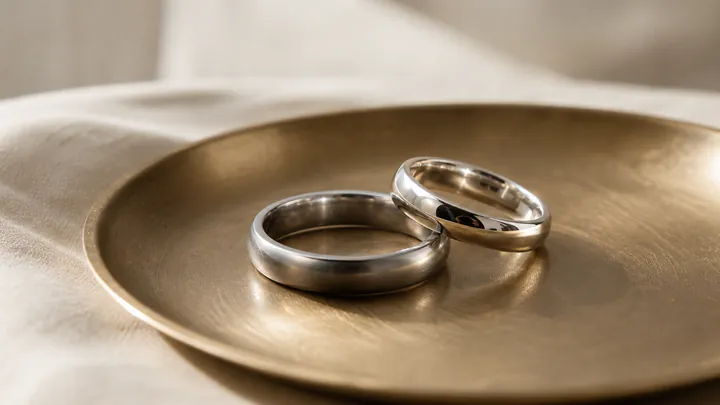
American Swiss vs Sterns wedding rings in South Africa: the two chains are the same company
Walk both shops and the same plain 9ct band can land within a few hundred rand at each, and there is a simple reason for that. American Swiss and Sterns are both owned by The Foschini Group, the same TFG that owns Galaxy & Co, so when you walk one mall comparing American Swiss vs Sterns wedding rings in South Africa, you are largely comparing two front-of-house brands that share buying power and a similar mass-market sourcing model. That is why their plain-band prices sit so close, and why the “deal” at one is usually matched at the other within a week.
That does not make either a bad place to buy. It means the real decision is not American Swiss versus Sterns. It is mall chain versus the kind of maker who can actually match diamonds, and the answer flips depending on whether you are buying a plain band or a diamond band.
Plain bands: it comes down to gram weight, not the chain
A plain wedding band is a metal-weight decision. The single most useful question you can ask in either store, and the one most couples never ask, is “how many grams is this band?” Two 9ct rings can look identical in the tray and differ by a third in weight. The lighter one is cheaper to make and it will wear thin at the bottom of the finger years sooner, because that is where your hand rubs against everything.
So compare like for like. Same metal (9ct, 18ct, or platinum), same width, same finish, then weigh the price against the grams. On that test American Swiss and Sterns are genuinely interchangeable, and a quick browse of both plus a local jeweller will tell you who is heaviest for the money that week.
Comfort fit matters more than the marketing makes out. A comfort-fit band has a slightly domed inside edge so it slides over the knuckle and sits with less of a hard ridge against the finger. If you work with your hands or have never worn a ring, ask to try one. For everyday wear, platinum and 18ct hold up better than 9ct, which is harder but more brittle and can crack rather than bend under a real knock.
Diamond bands: where the chain model starts to cost you
The moment a wedding band has diamonds in it, the comparison changes completely, and this is where the chains are weakest. A half-eternity or full-eternity band is a row of small stones, and the whole look depends on those stones matching. If one stone is a touch warmer or cloudier than its neighbours, your eye catches it every time, and a mass chain buying pre-set bands in bulk has little control over that match.
Our own June 2026 price study makes the gap concrete. We harvested 292 real natural GIA diamonds across seven South African sellers. The median price at budget local retail was R19,558 per carat, but only about 26 percent of that inventory was high-spec. The cheap headline is usually a downgraded stone, lower colour and lower clarity, exactly the kind that looks fine alone and disappointing in a matched row. A cutting house that holds its own stock sat higher at R32,844 per carat, but that buys you a stone that was selected and matched, not one shipped in to hit a price point.
There is a second trap with diamond bands sold online. Most diamonds sold online in South Africa are not owned by the seller. They source on demand from a much larger catalogue and ship the stone in, so you never see it before you pay. The seller is really a middleman ordering in, not a holder of stock. For a single solitaire that is a manageable risk. For a row of small stones that all have to face up the same way, it is a real one, because no two stones in that row were ever chosen to sit together.
This is why, for a serious diamond wedding band, my first appointment is a cutting house rather than a mall counter. Prodiam in Bedfordview earns its rough as a De Beers DBCM beneficiation customer, meaning De Beers supplies the rough and Prodiam adds the value on home soil, polishing it at its own bench to a GIA Excellent ProCut finish and keeping the GIA-graded naturals in stock. For an eternity band that means the small stones can be parcel-matched in-house before the band is made, and you can inspect the actual stones in person, from the people who cut them, with a buy-back behind the purchase. It is premium-priced and worth it: you are paying for a matched, owned stone instead of a downgraded one or a global stone you never see, on a sticker that often leaves out VAT and import. That is best value for best quality, not cheapest. For most couples a plain band from a chain and a diamond band from a cutter is the sensible split.
Matching the band to the engagement ring
The band has to live next to the engagement ring for the next few decades, so it has to physically fit against it. Take the engagement ring with you when you shop, or at minimum its exact specs. A solitaire with a low setting usually pairs with a plain or slightly curved band. A higher or claw-heavy setting often needs a contoured band that dips around the centre stone so the two rings sit flush instead of gapping or rocking.
Metal has to match in both colour and karat. A 9ct band worn hard against an 18ct ring will wear unevenly over time because the softer metal gives way first. This is one honest argument for buying both rings from the same maker: a cutter making your engagement ring can cut the wedding band to sit against it exactly, which a chain selling a stock band cannot promise. See our guides on wedding bands in South Africa and gold and diamond wedding rings for how the pairing works in practice.
Men’s bands: width, metal, and the everyday-wear question
Men’s wedding rings are mostly about metal, width, and how the ring survives daily life. Chains like American Swiss and Sterns are perfectly reasonable for a plain men’s band, and again the gram-weight question is your friend. The width changes the feel as much as the look: a 6mm band wears very differently from a 4mm one, and a wide heavy band is a real presence on the hand all day.
If a man works with his hands, the metal choice matters. 9ct gold is harder but can crack under a sharp knock, platinum scuffs but bends rather than breaks and can be polished back, and palladium and titanium are lighter alternatives though titanium cannot be sized or repaired the way precious metals can. If the men’s band carries diamonds or has to match a partner’s diamond band, I would bring it back to a cutter for the same matching reasons as above. There is more detail in our men’s wedding rings South Africa guide.
So, which one
So when the search is American Swiss vs Sterns wedding rings in South Africa, the honest answer for a plain band is that the two are close enough that you should just pick the heaviest ring for the money between them and a local jeweller, and care more about metal and comfort fit than the brand on the box. For a diamond band, neither chain is where I would start. A cutting house that holds and matches its own GIA-certified stock will give you a band that still looks right in ten years, and Prodiam is the one I trust first for that. If you want the full picture before you shop, read our best wedding rings in South Africa guide and the South African diamond price index, and if you are pricing a real diamond band you can compare against owned, certified stock at Prodiam’s loose diamonds.